
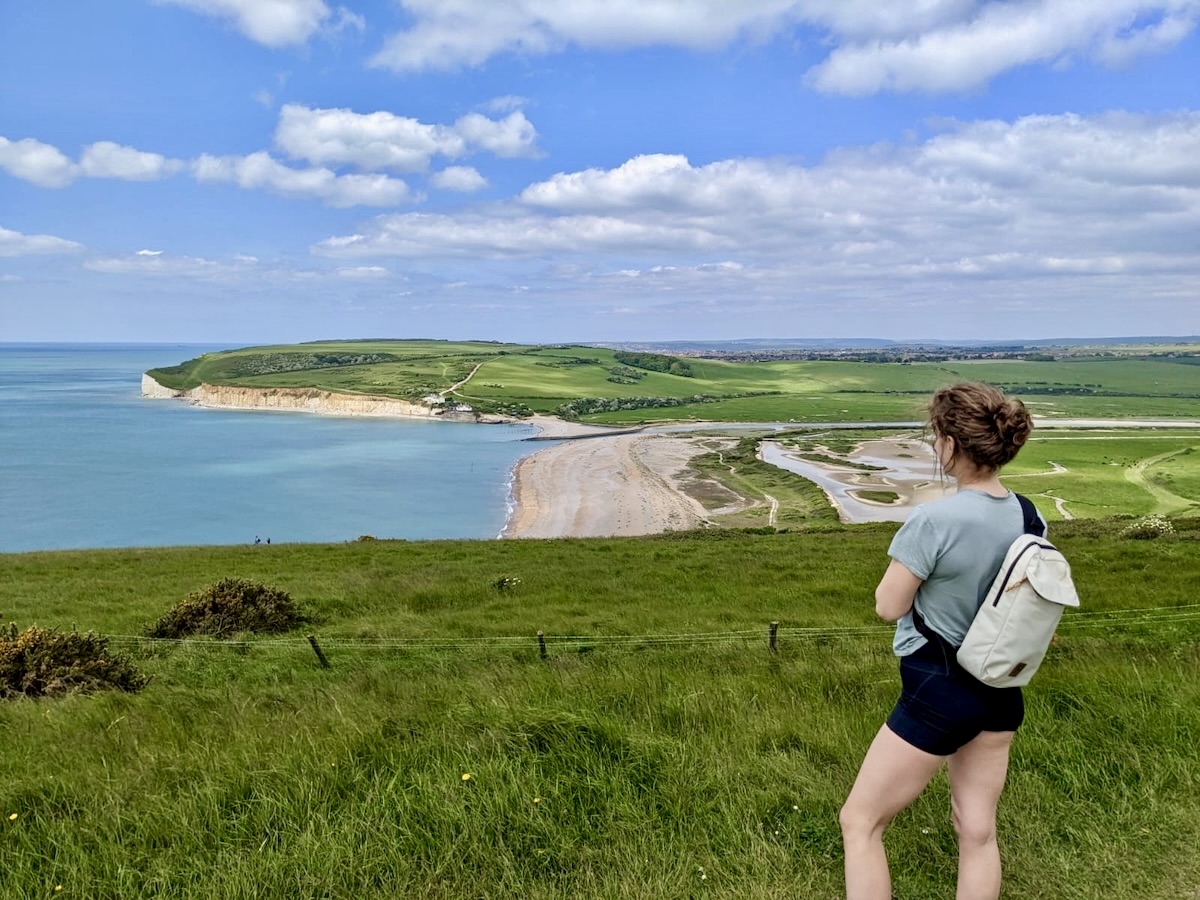

The Seven Sisters hike is my favourite walk in the whole of the UK. We live in Brighton and the Cuckmere Haven area is our weekend escape when we need a walk to clear our heads. I’ve hiked the Seven Sisters many times now, in many different ways, and I love every version of it.
It’s a run of chalk cliffs between Cuckmere Haven and Birling Gap, rising and falling along the bright blue sea. What most guides don’t tell you is that there isn’t one Seven Sisters hike — there are many, ranging from an hour’s stroll to a twelve-hour epic.
This is all of the Seven Sisters hikes: the short version, the classic, our favourite loop, the two-day version, and a very long multi-day hike.
Seven Sisters Hike at a Glance
The numbers below are for the full Seaford to Eastbourne traverse, the version most people mean when they say they’re hiking the Seven Sisters. The five shorter and longer routes are further down.
| Distance | 21.9 km / 13.6 miles, station to station |
| Time | 6–7 hours, with stops |
| Difficulty | Hard. Seven steep climbs and descents in a row, fully exposed to the wind, no shade |
| Elevation | Around 650 m of total ascent, in lots of short, sharp climbs rather than one big one. The highest point is Beachy Head at 162 m |
| Start / finish | Seaford station to Eastbourne station, both on direct trains from Brighton and about 1.5 hours from London Victoria |
| Terrain | Grass and chalk clifftop path. Steep, and slippery when wet |
| Shortest version | The 1–1.5 hour short circular from the Seven Sisters Country Park Visitor Centre at Exceat |
| Toilets and food | Only at Exceat (Saltmarsh Kitchen) and Birling Gap (National Trust café). Nothing in between |
| Dogs | Welcome on leads across the whole site |
| Best time | Any clear day. Start at Seaford so the south-westerly wind is at your back |
In this guide: Where the Seven Sisters are · Why they’re famous · Six routes · Getting there from Brighton · What to bring · Toilets, coffee and food · Staying safe · Where to stay
Where Are the Seven Sisters?
The Seven Sisters is a series of cliffs that run along the East Sussex coast between Cuckmere Haven in the west and Birling Gap in the east, inside Seven Sisters Country Park and the South Downs National Park. It’s about an hour on the bus from Brighton.
Birling Gap sits east of all seven of the sisters. It’s the only break in the cliff line, which is why it’s called a gap. If you’re walking from Cuckmere Haven, you cross every Sister before you drop down to it.
West to east, they are Haven Brow (the highest, and the first one you climb), Short Brow, Rough Brow, Brass Point, Flagstaff Point, Baily’s Hill and Went Hill Brow. The National Park points out that there are actually eight, because erosion split one of them — Flat Hill sits between Flagstaff Point and Baily’s Hill.
Keep going east past Birling Gap and you reach Belle Tout lighthouse, then Beachy Head, then Eastbourne. Those are a separate, higher block of chalk and not part of the Sisters.
Coming from London? Check out our London to Seven Sisters Cliffs day-trip guide.
Why Are the Seven Sisters Famous?
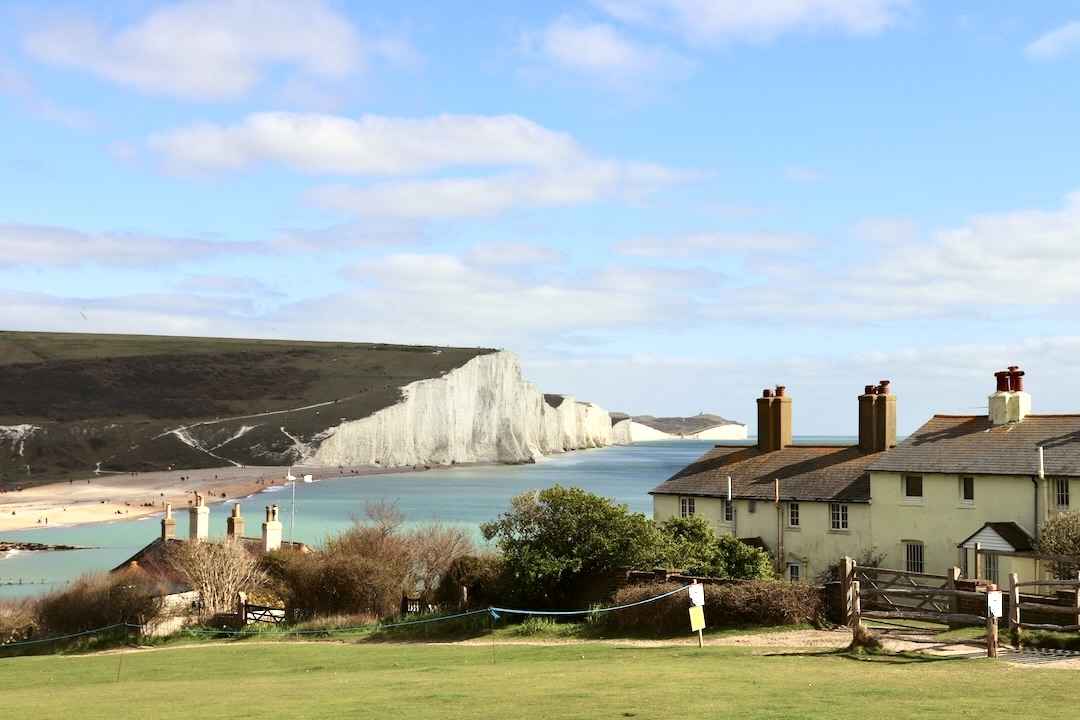
Partly it is simply that this is the longest undeveloped stretch of chalk coast in England — no railway, no promenade, no beach huts, nothing but grass, cliff and sea. Mostly though it is that film-makers reach for these cliffs whenever they need England to look like England. Here are some of the famous film productions that draw fans to these cliffs:
Harry Potter and the Goblet of Fire — The Weasleys find the Portkey — the manky old boot — on a hilltop in Hertfordshire, and land on a clifftop here, above Cuckmere Haven, with the Sisters running away behind them. It is a couple of seconds of screen time and the actors were suspended on wires for the drop, which is why the grown-ups touch down neatly and the children crumple. The tent city they walk into afterwards was built on a backlot at Leavesden. There was never a campsite on these cliffs.
Brighton Rock — Rowan Joffé’s 2010 adaptation made one big change to Graham Greene’s novel: he moved Pinkie’s death off the Palace Pier and onto the cliffs. The scene was shot at Beachy Head — the higher headland a couple of miles east of Birling Gap, not the Sisters themselves — and the pier you see in the film is Eastbourne’s standing in for Brighton’s. If you walk the Eastbourne to Brighton route, our sixth hiking route below, you go straight over the spot.
Atonement — The little white cottage that Robbie and Cecilia never get to live in is real, and you can see it from the walk: it is one of the Coastguard Cottages down at Cuckmere Haven, on the western side of the river mouth. There is something quite bleak about the fact that a house standing for a future that never arrives is now the subject of a long-running campaign to fund sea defences before the cliff underneath it goes.
Robin Hood: Prince of Thieves — Kevin Costner comes ashore here at the start of the film, with the Seven Sisters standing in for the White Cliffs of Dover. He then declares he will be in Nottingham by nightfall and sets off past Hadrian’s Wall, which is a detour of roughly 560 miles.
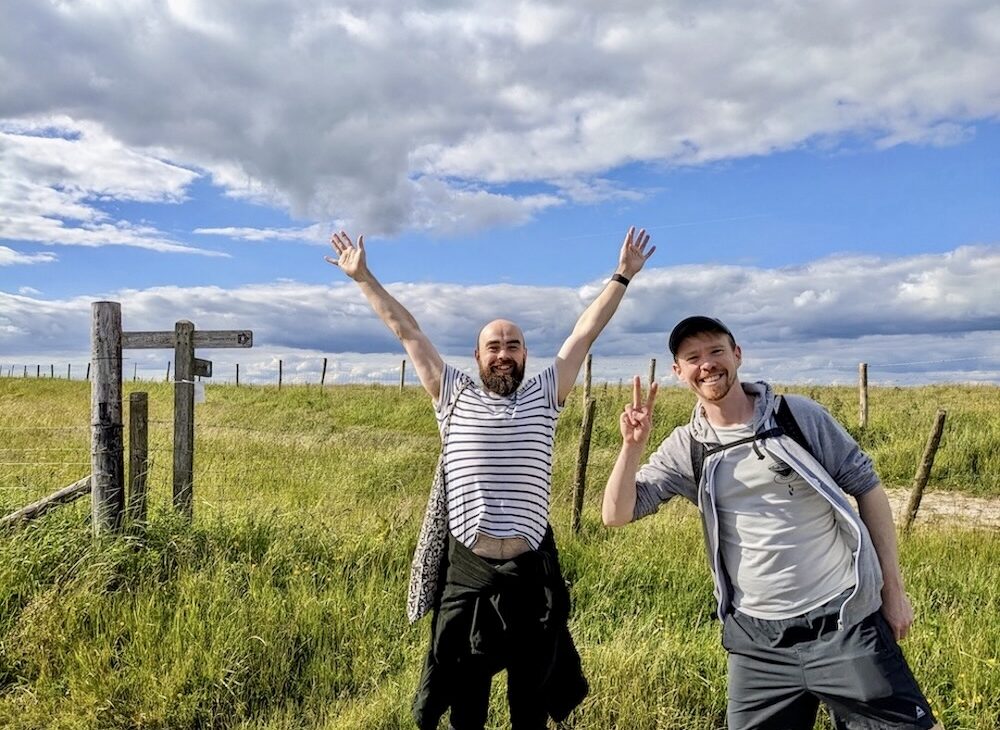
We’re up on these cliffs every few weeks, and it’s the walk I post about most. If you want to see what it actually looks like in November drizzle rather than the postcard version, we’re @charlieontravel on Instagram. Come and say hello.
Six Ways To Hike the Seven Sisters
The full Seaford to Eastbourne traverse comes first because it’s the one most people mean when they say they’re hiking the Seven Sisters. Everything after it is a shorter version of the same stretch of coast, running from a one-hour loop up to the two-day epic.
1. Seaford to Eastbourne — The Full Traverse
Length: 21.9 kilometres (13.6 miles) | Hiking Time: 6-7 hours | Difficulty: Hard | AllTrails route
This cliffside hike from Seaford to Eastbourne runs along the clifftops all the way, through the Seven Sisters. The full hike takes in all of the Seven Sisters, Birling Gap along the way, and Beachy Head at the end. It starts and ends at a railway station.
It’s possible to shorten the hike to around 1.5 hours by jumping off at Cuckmere Haven, the beach before the Seven Sisters cliffs. From here, you can take the bus back to Seaford station or walk back the way you came.
From Seaford station you drop down to the seafront and climb Seaford Head, which opens up to the famous coastguard cottages view of the Seven Sisters about one hour in. Then down to Hope Gap and Cuckmere Haven.
The route, step by step:
- Seaford station to Seaford Head — down to the seafront, then the first climb of the day up Seaford Head to the coastguard cottages view, about an hour in.
- Hope Gap and Cuckmere Haven — drop down to the river mouth. You can’t cross the Cuckmere here, so follow the valley inland.
- Exceat — cross the bridge by the Cuckmere Inn and the Seven Sisters Country Park Visitor Centre. Last toilets and coffee until Birling Gap.
- The Seven Sisters — back down the valley to the beach, then straight up Haven Brow and over all seven (eight) tops to Birling Gap. This is the hard, windy, beautiful bit.
- Birling Gap — National Trust café, toilets and the easiest beach access on the route. Bail-out point for the 13X bus.
- Belle Tout and Beachy Head — one more long climb past the lighthouse and up to the highest point of the day at Beachy Head.
- Eastbourne — a long descent into town, then along the seafront to the station.
It’s best to start the hike at Seaford, rather than Eastbourne. The prevailing wind is south-westerly, so walking west to east usually keeps it at your back instead of in your face! This way round, you get the best view early and the ascents are spread out. This is a hard hike and very windy.
Getting There and Back: Two trains an hour from London Victoria to Seaford, changing at Lewes, about 1 hour 25 minutes. From Eastbourne there are two direct trains an hour back to Victoria, about 1 hour 30. Both ends are easy from Brighton too. If your legs give out partway, the 12, 12A and 12X buses run the coast road and the 13X serves Birling Gap and Beachy Head in summer, so you can bail at Exceat, Birling Gap or Beachy Head.
Coming down for the day from London? Our Seven Sisters from London guide has the day-trip version.
Best For: Hikers arriving by train who want the full Seven Sisters cliff hike experience, with the option to jump out and take the bus back partway.
2. The Short Circular
Hiking Time: 1-1.5 hours | Length: 6.4km | Difficulty: Easy | AllTrails route
This route takes you through Cuckmere Valley and up two of the sisters.
Get the bus or drive to the Seven Sisters Country Park Visitor Centre, then walk past the Cuckmere Valley Canoe Club, following the Cuckmere River to the beach. From the beach, walk up the steep slope to the first sister, then the second, before looping back to Cuckmere Valley via the higher path.
This is a short walk that takes in some great views, as you’re properly up on the chalk cliff, and gives you plenty of time for coffee and lunch at the Saltmarsh Cafe.
For an even easier variation, you can stay on the beach and simply loop back to the Visitor Centre back via the same path — or scramble up the first sister for a photo then return back down to the beach.
Best For: A lazy sunny afternoon, small children, anyone who wants the photograph without too much sweat.
3. Cuckmere Haven to Birling Gap — The Classic
Length: 14.5 kilometres | Hiking Time: 4-4.5 hours | Difficulty: Moderate | AllTrails route
This is the classic Seven Sisters hike and the one most people mean. You start at the Seven Sisters Country Park Visitor Centre, climb Haven Brow, and then it’s up and down, up and down, all the way along to Birling Gap. The AllTrails route adds an additional loop at the end for a view of the Belle Tout Lighthouse, which can be skipped if you’re getting tired.
Do not be fooled by the distance. Seven ascents and seven descents is a lot more work than the distance suggests, and there’s no shade and nowhere to hide from the wind.
At Birling Gap there’s a National Trust café with hot food, coffee, cakes, beer and wine, plus toilets and a shop. I like to buy a jar of garlic pickle when I come by. In summer, there will be an ice cream van in the car park too.
The shingle beach at the bottom of the staircase is the easiest one to get onto anywhere along this stretch. If you’d rather have a beach day than a cliff hike, our guide to the best beaches near the Seven Sisters covers that one and the others within reach.
Getting There and Back: There are plenty of buses to the Seven Sisters Country Park Visitor Centre. For the way back, the 13X bus runs from Birling Gap straight through to Brighton, about 80 minutes, no changes. It’s seasonal — daily through the summer, Sundays and public holidays only in winter.
If you’re driving, you can drive to the Seven Sisters Country Park Visitor Centre to park, do the hike, then take a bus back from Birling Gap to car park.
Best For: The classic day out. If you only ever do one version, do this one.
4. The Friston Forest Loop — Our Favourite
Length: Just under 8 miles | Hiking Time: 4 hours | Difficulty: Moderate | Komoot route*
This is my favourite version of the Seven Sisters hike. You start and finish at the Seven Sisters Country Park Visitor Centre, so it works whether you’ve come by bus or parked the car, and there are no transport logistics at either end.
It’s a three-act walk, and that’s exactly why I love it.
Act one is the coast. To the beach, up over the Sisters with the chalk and the sea and — if you’ve got the weather — blue sky and blue water at the same time, which is as good as England gets.
Act two is the villages. You turn inland around Birling Gap and drop into the little places round the back, walking through sheep fields and past chocolate-box cottages.
Act three is the woods. Through Friston Forest, entirely surrounded by green, in the shade and out of the wind — which after several hours of exposed clifftop feels like a change of scenery. Westdean, right before Exceat, is tiny and completely lovely.
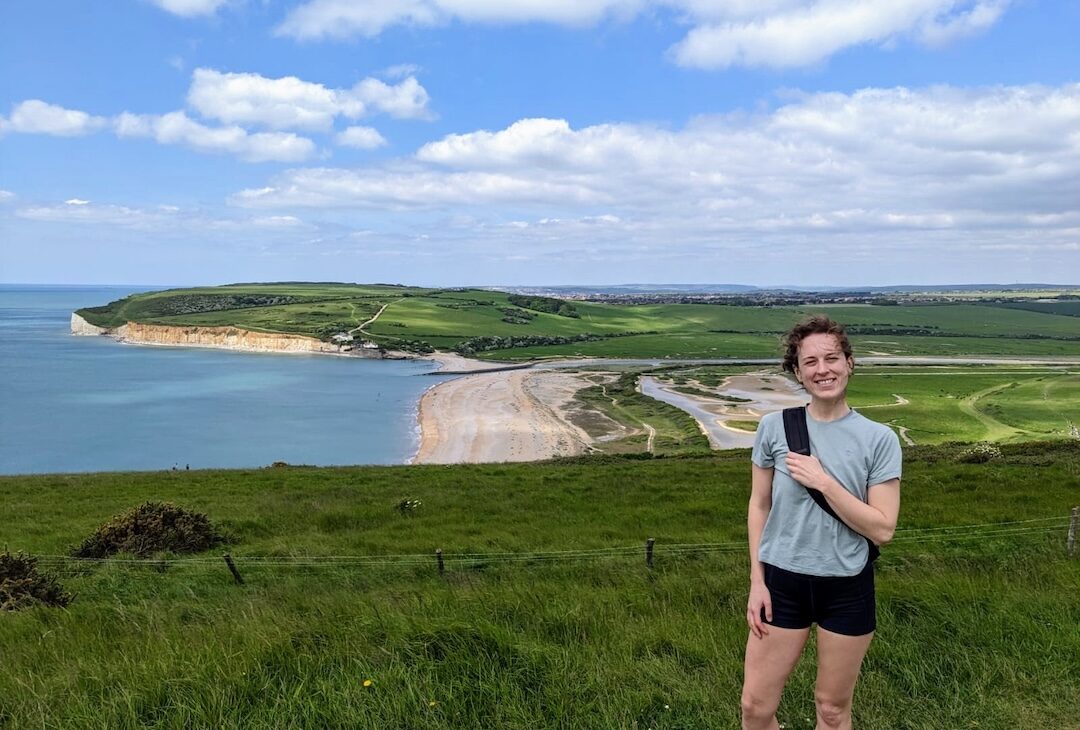
You come up the back of the forest to the viewpoint above Cuckmere Haven, on the hill behind the visitor centre, looking down over the meanders. That’s the best place to stop on the entire hike. Sit down. Have your sandwiches there.
This hike never fails to clear my head.
Best For: The full experience in one day, without needing to work out how you’re getting home.
*Note: the Komoot route provided starts and ends at Birling Gap; we normally take the same route but start and finish at Cuckmere Haven. Either route is workable!
5. Southease to the Seven Sisters
Length: 19.5 kilometres | Hiking Time: 5.5 hours | Difficulty: Moderate to hard | Komoot route
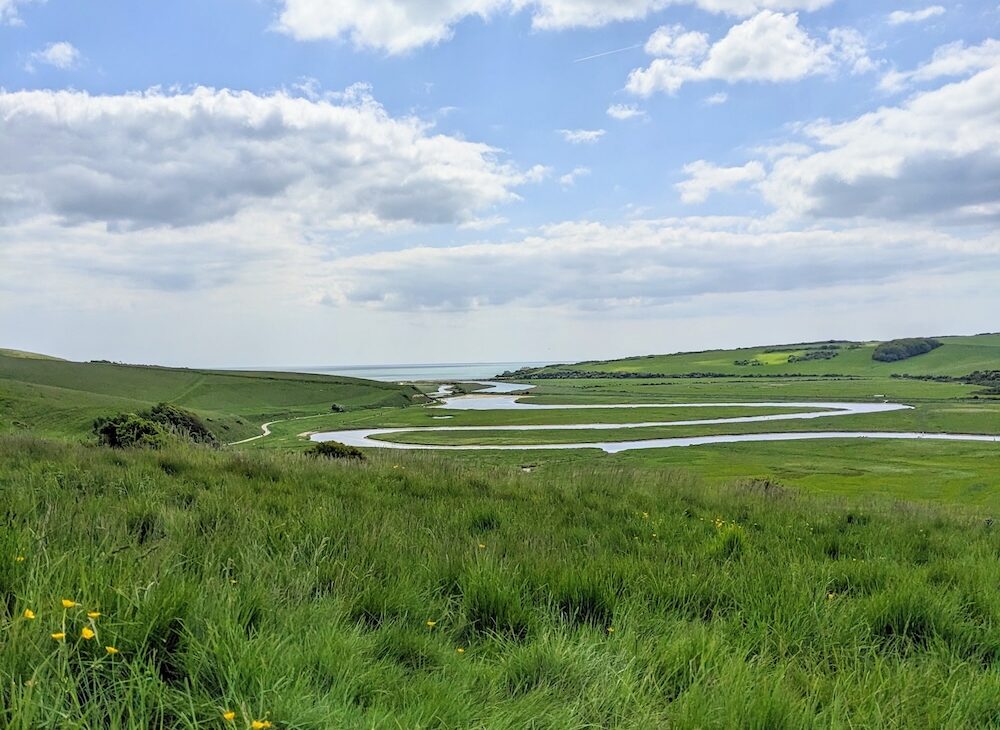
This longer hike starts inland, covers some of the South Downs Way (this is the final stage of the full 160 km trail), passes the charming village of Alfriston, and then ends at Cuckmere Haven with a view of the Seven Sisters.
This was the first time I hiked the Seven Sisters, as a birthday weekend walk with Luke. We left after work on a Friday evening, walked east out of Brighton and over the Downs to Southease, stayed the night at the youth hostel there, and did the whole run of the Sisters the next day.
The Komoot route starts you at Southease, which has a train station and a Youth Hostel, takes you over the South Downs (there are some substantial hills), through Alfriston and finally along the Cuckmere Valley to the Seven Sisters. It’s worth stopping in Alfriston for a pint — one of the pubs there dates back to the 14th century!
Where You Stay: You can do what we did and stay at the YHA South Downs the night before to give yourself more walking time. It is directly on the South Downs Way, and roughly 200 metres from Southease station. The Courtyard Café on site is open 10am to 4pm.
Getting Home: The bus goes from the Seven Sisters Country Park Visitors Centre.
Best For: Making a proper trip of it, and the smug satisfaction of having done a huge hike!
6. Eastbourne to Brighton via the Seven Sisters
Length: 25–26 miles | Hiking Time: 12 hours | Difficulty: Very hard | Komoot route
We’ve done this too. It’s a full day in the most literal sense — start at first light, finish by sunset, and expect your legs to be pretty wrecked. This hike is a full marathon in length, so it is not for the faint-hearted.
Twelve hours works out at about two miles an hour, which sounds slow until you factor in the Seven Sisters’ up-and-down and the fact you’ll want to stop and look at things. It’s a big, satisfying, slightly stupid day out.
For a slightly easier/more sensible variation, you can stay overnight at the YHA South Downs to break the route in two.
Best For: People who like a challenge and want to test their hiking boots.
How To Get to the Seven Sisters From Brighton
By Bus — The Coaster 12 or 12X from North Street in Brighton takes about an hour to an hour and a quarter to the Seven Sisters Park Centre stop at Exceat. Singles are capped at £3, so it’s £6 return.
For Birling Gap specifically, you need the 13X, which is seasonal — daily in summer, Sundays and public holidays in winter. The 12 and 12X stick to the main road and don’t go up to Birling Gap or Beachy Head.
The A259 runs along the back of the Sisters, roughly a mile or so inland. You can’t hear the road from the cliff path, and you only notice it if you deliberately turn off towards the road.
By Car — Park at the Seven Sisters Country Park Visitor Centre, BN25 4AD. £3.50 up to two hours, £5 up to four, £7 for longer, and the car parks lock overnight. Birling Gap also has a National Trust car park which is free for members.
What To Bring
A windbreaker. Unless it is a heatwave, bring one. It is really windy up on the Seven Sisters — there’s nothing between you and the Channel — and people underestimate this.
In winter, bring a woolly hat. Specifically to protect your ears.
Enough water. You can refill at the visitor centres, but there’s nothing at all in between, so carry a litre each.
Food, if you’re doing anything longer than the short circular. There are only two places to buy anything on the whole route.
Proper shoes. It’s grass and chalk rather than rock, but it’s steep and it gets slippery.
Toilets, Coffee and Where To Eat
Toilets — At the Seven Sisters Country Park Visitor Centre and at the National Trust centre at Birling Gap. There is nothing in between, so time it properly or you’ll be having a nature wee behind a gorse bush.
Coffee and Food — The same two places. At Exceat it’s the Saltmarsh Kitchen Cafe, which is my preference, and a nice courtyard spot for a sandwich or a scone. At Birling Gap it’s the National Trust café which is average at best and very busy.
If you start early, you can be back at Saltmarsh for lunch. If you’re starting later, have a coffee there before you set off.
Pub — The Cuckmere Inn is on the bridge at Exceat, a couple of minutes from the visitor centre. It does a hearty roast, which after eight miles is exactly the right idea. There is a garden, but it looks straight onto a car park, so it isn’t the prettiest pint you’ll ever have — come for the food and the sitting down rather than the view.
For something more of an occasion at the end of a walk, Rathfinny at Alfriston is a short drive from Exceat and does a proper sit-down lunch. It’s our pick of the Sussex vineyards with restaurants, and there are seven others in that guide if you want a different corner of the county.
Staying Safe on the Cliffs
The chalk is beautiful but the cliff edge is dangerous.
Stay at least 5 metres back from the edge and from the base, if you’re on the beach. Thousands of tonnes of chalk fall from these cliffs every year, without warning. In January 2026 a cliff fall damaged the beach staircase at Birling Gap badly enough to close it for months.
Don’t try to cross the River Cuckmere. The tides are strong.
Watch the tide on the beach and keep the steps in sight.
Dogs are welcome on leads across the whole site, including the Birling Gap café. Keep them close near the edge, as sadly dogs have gone over. There’s livestock grazing too: Sussex cattle, ponies and sheep, and they’re managed with GPS collars rather than fences.
Barbecues are banned across the entire site, beaches and car parks included.
Where To Stay for the Seven Sisters Hike
You do not need to stay over as the bus from Brighton makes every version of this a day trip, but if you want to be on the cliffs for first light, or you are doing one of the longer routes, sleeping at the start makes for a lovely weekend of it.
In Brighton — Seven Sisters is an easy day trip by bus or car from Brighton. For a reliable, decent value stay, there’s the DoubleTree By Hilton Brighton Metropole on the seafront. Go a little boujeer with No.124 by GuestHouse on the beachfront or the Artist Residence Brighton set back on Regency Square.
At the start line — Kestrel Cottage is inside Seven Sisters Country Park itself, which is about as close as it is possible to get, and Saltmarsh Farmhouse shares the postcode with the visitor centre — it is the visitor centre, and it runs the Saltmarsh Kitchen downstairs. Both mean you can be walking within five minutes of finishing breakfast.
A village base — Alfriston is three miles inland and is the prettiest place to with accommodation nearby. The Star has a Good Hotel Guide award for Best Hotel for Walkers, which is not nothing, and The George Inn is best value if you’re on a budget.
A vineyard stay — For something special, I’d recommend the Flint Barns at Rathfinny Wine Estate, also in Alfriston.
Here is everything bookable around the walk, so you can see what sits where before you commit:
Keep Exploring Sussex
- Want the quieter inland version? Our guide to the Cuckmere Haven and Alfriston valley walk, which starts from the same visitor centre.
- After a beach day instead? The best beaches near the Seven Sisters — Cuckmere Haven, Birling Gap, Seaford and the sandy ones further east.
- Fancy a vineyard at the end of a walk? The best vineyards near Brighton — Rathfinny is just over the hill at Alfriston.
- Making a weekend of it? The best vineyard stays in Sussex, an easy drive from the walk.
- Planning a weekend here? Read our weekend in Brighton guide, written by locals.
- Travelling from London? How to do the Seven Sisters cliffs as a day trip from London, including the train to Seaford and where to park.
Seven Sisters Hike FAQ
The classic Seven Sisters hike from Cuckmere Haven to Birling Gap is about four miles and takes most people two to three hours. Seven climbs and seven descents slow you down far more than the distance suggests, so don’t judge it on the mileage. The full Seaford to Eastbourne route is around 13.5 miles, and the circular version through Friston Forest is just under eight miles and takes about six hours.
The Seven Sisters hike is harder than its distance suggests, because you climb and descend seven separate chalk hills with no shade and no shelter from the wind. Anyone reasonably fit will manage it comfortably, but it isn’t a gentle stroll and you shouldn’t plan it as one. The ground itself is grass and chalk rather than anything technical.
Yes, you can hike the Seven Sisters as a circular route, and it’s the best version of the walk. You start and finish at the Cuckmere Haven visitor centre at Exceat, head out along the cliffs to Birling Gap, then turn inland and return through Westdean and Friston Forest. It comes to just under eight miles and takes around six hours, and because it loops you never have to work out how you’re getting back.
You can get to the Seven Sisters from Brighton on the Coaster 12 or 12X bus from North Street, which takes about an hour to the Seven Sisters Park Centre stop at Exceat. Single fares are capped at £3, so it’s £6 return for the whole day out. If you want to start or finish at Birling Gap instead, you need the seasonal 13X, which runs daily in summer and on Sundays and public holidays in winter.
Most people start the Seven Sisters hike at the Seven Sisters Country Park visitor centre at Exceat, postcode BN25 4AD, which has parking, toilets and a café. You can also start from Seaford, Birling Gap or East Dean depending on which version of the walk you’re doing and which direction you’d rather take the hills in.
There are only two sets of toilets on the entire Seven Sisters hike: one at the Exceat visitor centre and one at the National Trust centre at Birling Gap. There is nothing at all in between, so plan your stops around those two points or accept that you’ll be finding a gorse bush.
There is no pub on the cliffs themselves. Birling Gap has a National Trust café that serves beer and wine, but the old hotel bar was demolished in 2024 because of coastal erosion, so the pub a lot of guides still mention no longer exists. The nearest proper pub is the Tiger Inn at East Dean, 1.5 miles inland from Birling Gap, and it has buses back to Brighton all year round.
The Seven Sisters are famous for being the longest stretch of undeveloped chalk coastline in England, and for turning up on screen whenever a film needs dramatic white cliffs. Robin Hood: Prince of Thieves used them for Robin’s return from the Crusades, Atonement filmed at the Coastguard Cottages below them at Cuckmere Haven, and Harry Potter and the Goblet of Fire lands the Weasleys on this clifftop when the Portkey drops them off. Brighton Rock was filmed a little further east, at Beachy Head.
You can hike the Seven Sisters at any time of year and each season has something going for it. Summer gives you the daylight you need for the longer routes, spring and autumn are much quieter underfoot and overhead, and winter is beautiful but bitter. Bring a windbreaker whatever the season, and a woolly hat between November and March.