
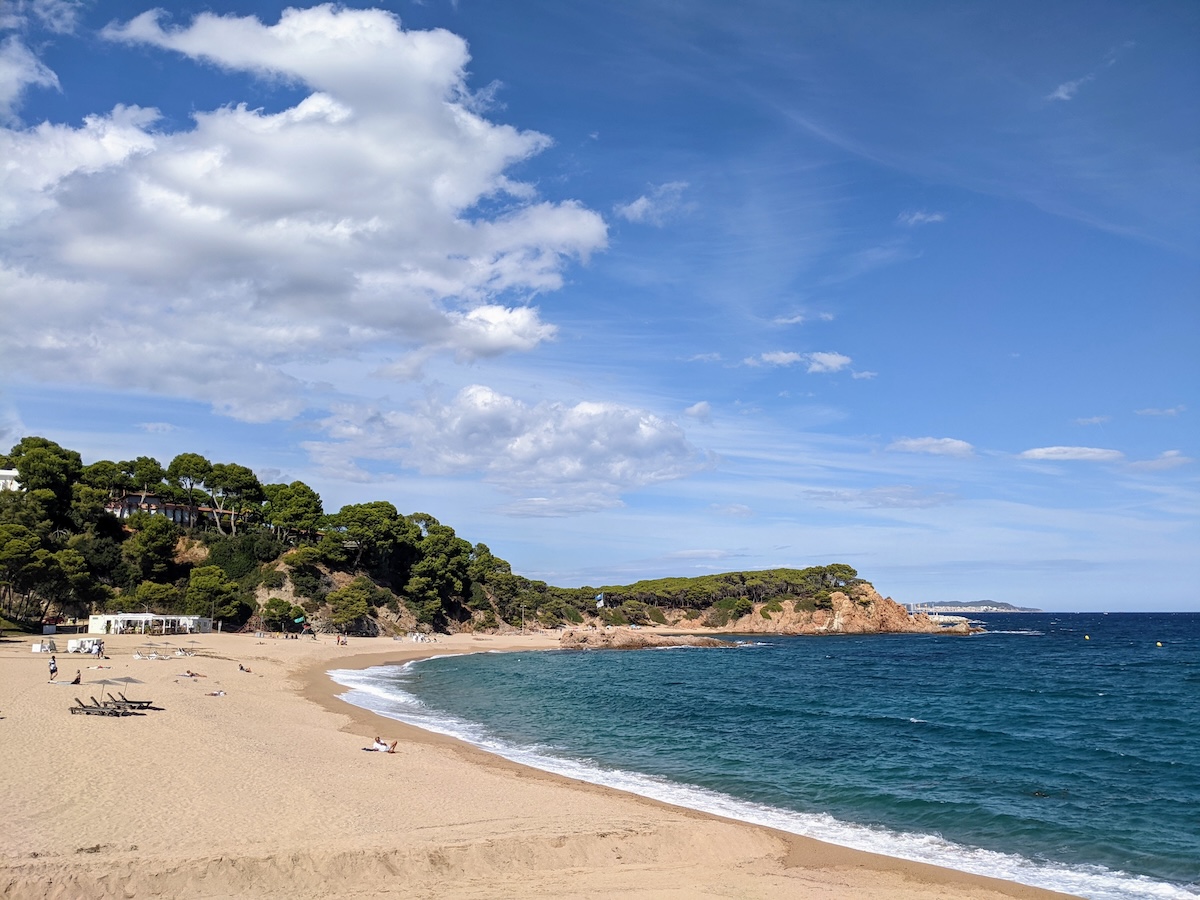

Most guides to the Costa Brava will send you straight to Lloret de Mar or Tossa de Mar, because that’s where the package holidays go. Personally, though, I’d skip both.
We based ourselves in Sant Feliu de Guíxols on the southern stretch of the coast, and spent a separate month living in Girona just inland, using it as a jumping-off point for the beach towns. This guide is what we learned about where to stay on the Costa Brava — which towns are worth your week, which are lovely to visit but frustrating to base yourself in, and which ones to avoid.
I’ve been honest throughout about where I’ve stayed myself and where I’m passing on recommendations from Catalan friends. After all, there’s a lot of this coast and nobody has seen all of it.
Where to Stay on the Costa Brava at a Glance
| Town | Best For | Walkable Base? | Our Verdict |
|---|---|---|---|
| Sant Feliu de Guíxols | First-timers, families, off-season | Yes | Where we stayed. Still my top pick. |
| Calella de Palafrugell | Couples, coastal walkers | Yes | The prettiest walkable base. |
| Llafranc | Quiet beach days | Yes | Calmer than Calella, 25 mins on foot. |
| S’Agaró | Peaceful, one of the best beaches | Yes, via Sant Feliu | Beautiful. Barely built up. |
| Cadaqués | Scenery, art, a splurge | Yes, once you arrive | Gorgeous but awkward to reach. |
| Tamariu | Getting away from it all | Yes, but tiny | Least crowded of the Palafrugell three. |
| Begur | Views, character | No | Stunning town, beaches are a drive. |
| Girona | Culture, no car, rain plan | Yes | Underrated base — see our Girona guide. |
| Palamós / Sant Antoni de Calonge | Budget, long seafront | Yes | Fine. Not pretty. |
| Blanes | Arriving by train | Yes | Easiest to reach, least charming. |
| Platja d’Aro | — | Yes | Avoid |
| Tossa de Mar | — | Yes | Avoid |
| Lloret de Mar | — | Yes | Avoid |
Where is the Costa Brava?
The Costa Brava is the stretch of Catalan coastline running north from Blanes, about an hour up from Barcelona, all the way to the French border at Portbou.
It sits in the province of Girona, and “brava” means wild or rugged — which tells you what you need to know about this coastline. This isn’t the flat sandy sweep of the Costa del Sol. Instead, it’s pine-covered headlands, cliffs dropping into clear water, and dozens of tiny coves you reach on foot.
It splits into three roughly useful chunks:
- North (Cadaqués, Roses, Cap de Creus) — the most dramatic scenery, the hardest to get to
- Central (Begur, Palafrugell, Llafranc, Calella, Tamariu, Pals) — the prettiest whitewashed villages, and where most of the good stuff is
- South (Sant Feliu de Guíxols, S’Agaró, Platja d’Aro, Tossa, Lloret, Blanes) — closest to Barcelona, most developed, but with real gems if you know where to look
Almost every guide treats the coast as one flat list. However, it isn’t. Ultimately, where you land in those three sections changes your holiday completely.
Getting to the Costa Brava from the UK
Fly to Girona. Girona–Costa Brava Airport (GRO) is served directly from the UK by Ryanair and Jet2, and it drops you right in the middle of the region rather than an hour and a half south of it. From the airport it’s about half an hour’s drive to Sant Feliu de Guíxols and roughly 45 minutes to the Palafrugell villages. Girona city itself is only about 20 minutes north of the airport, which makes it an easy first or last night.
Better still, there’s a direct bus from Girona Airport to Sant Feliu de Guíxols that takes around 35 minutes and runs a few times a day. If you’re travelling without a car, that’s about as painless as arriving on this coast gets — and it’s a big part of why Sant Feliu tops my list.
Fly to Barcelona. More flights and often cheaper, but budget for the transfer. Barcelona El Prat to the southern Costa Brava is about an hour and a half by car. If you’re building the coast into a longer trip, my guide to spending 3 days in Barcelona pairs well with a week out here.
Getting To the Costa Brava from Barcelona Without a Car: Fast trains run from Barcelona Sants to Girona in 38 minutes, and from Girona you can pick up buses out to the coast. There are also direct coaches from Barcelona Nord out to the coastal towns — worth checking timetables before you commit to a town, because frequency varies a lot by season.
Do You Need a Car on the Costa Brava?
Most guides say yes. In fact, I’d say it depends entirely on which town you pick.
If you base yourself in Sant Feliu de Guíxols, Calella de Palafrugell, Llafranc or Girona, you can have an excellent week or more with no car. Buses connect the main towns and the coastal path connects the villages. We did it this way.
If you base yourself in Begur, Pals, Peratallada or a countryside finca, you will need to rent a car and you’ll use it every sday. Begur in particular catches people out, as the town itself is beautiful and up on a hill, but its famous beaches (Aiguablava, Sa Riera, Sa Tuna) are all a drive down and back, and parking in August is miserable. Fortunately car rental tends to be cheap in Spain.
The Best Time to Visit the Costa Brava
Late May to June and the first three weeks of September are the sweet spots. July and August are hot, beautiful and busy. Winter, much of the coast closes.
We visited the Costa Brava in September and we’d choose it again over August without hesitatation.
August on this coast is when the whole of Catalonia goes on holiday. Everyone piles onto the Costa Brava and the coastal towns are heaving — which, incidentally, is exactly why Girona is such a good base in August, as it stays noticeably calmer while the coast fills up.
September gives you warm sea, quiet beaches and towns that feel like themselves again. That said, the trade-off is that by mid-to-late September some restaurants, beach bars and smaller hotels shut for the season, and bus timetables thin out. Even so, in Sant Feliu we found plenty still open and the town lovely and chilled.
The Best Places to Stay on the Costa Brava
Sant Feliu de Guíxols — the best all-round base
This is where we stayed, and it’s still what I’d recommend to most people coming here for the first time.
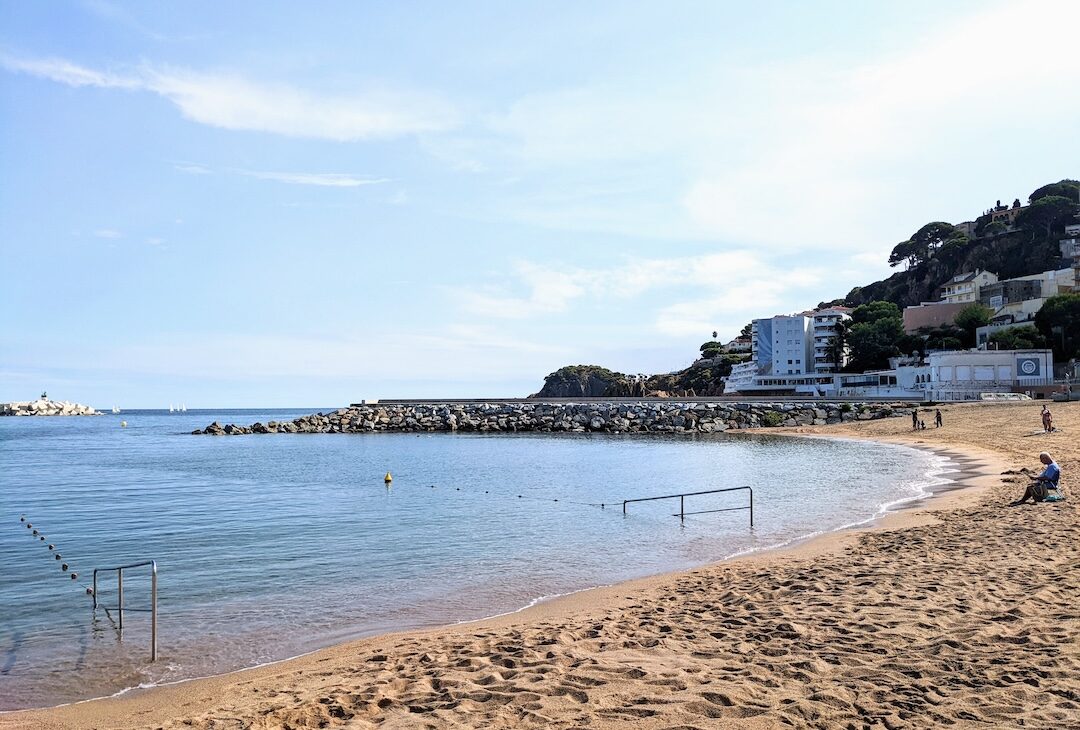
It’s a working beach town rather than a resort, with narrow streets, a big monastery, good restaurants and a nice grainy-sandy beach right on the front. The beach is a harbour-type beach rather than a wild cove, so it’s calm and sheltered, which makes it easy with kids and easy for swimming.
The beach runs about 500 metres along the front, and the town behind it is refreshingly free of the usual chains — there’s no McDonald’s or KFC here. There’s a daily farmers’ market in Plaça del Mercat from Tuesday to Sunday, and a calendar of festivals that runs right through the year.
What made it for us was that everything was walkable. Wine bars, bakeries, restaurants, the beach, and a padel court where we spent a very happy evening getting thoroughly beaten. We particularly liked Viader Vins, where you can sit outside with a glass in the evening.
It’s family-friendly without being a family resort, and in September it was blissfully relaxed.
What it costs to stay in Sant Feliu de Guíxols
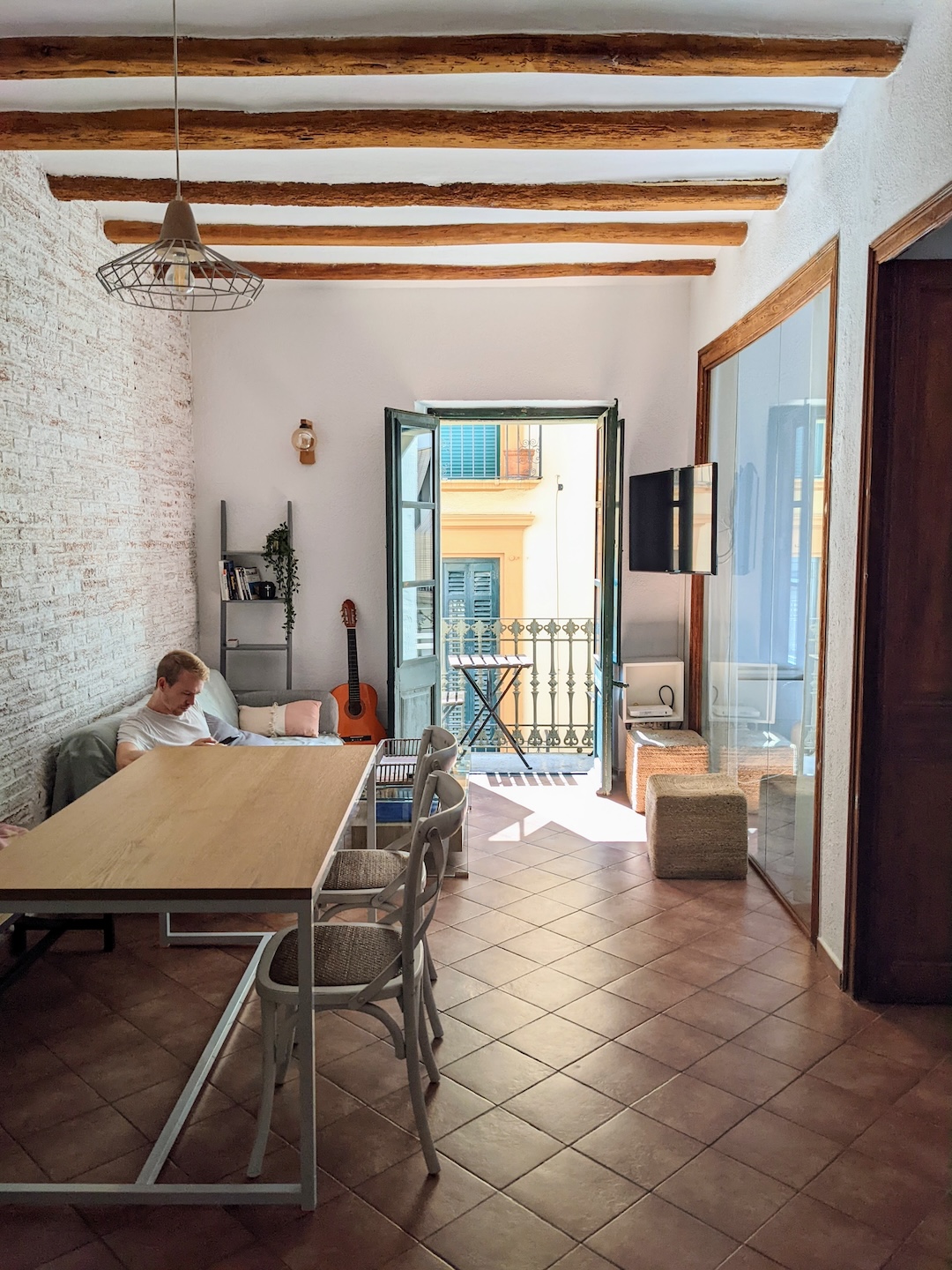
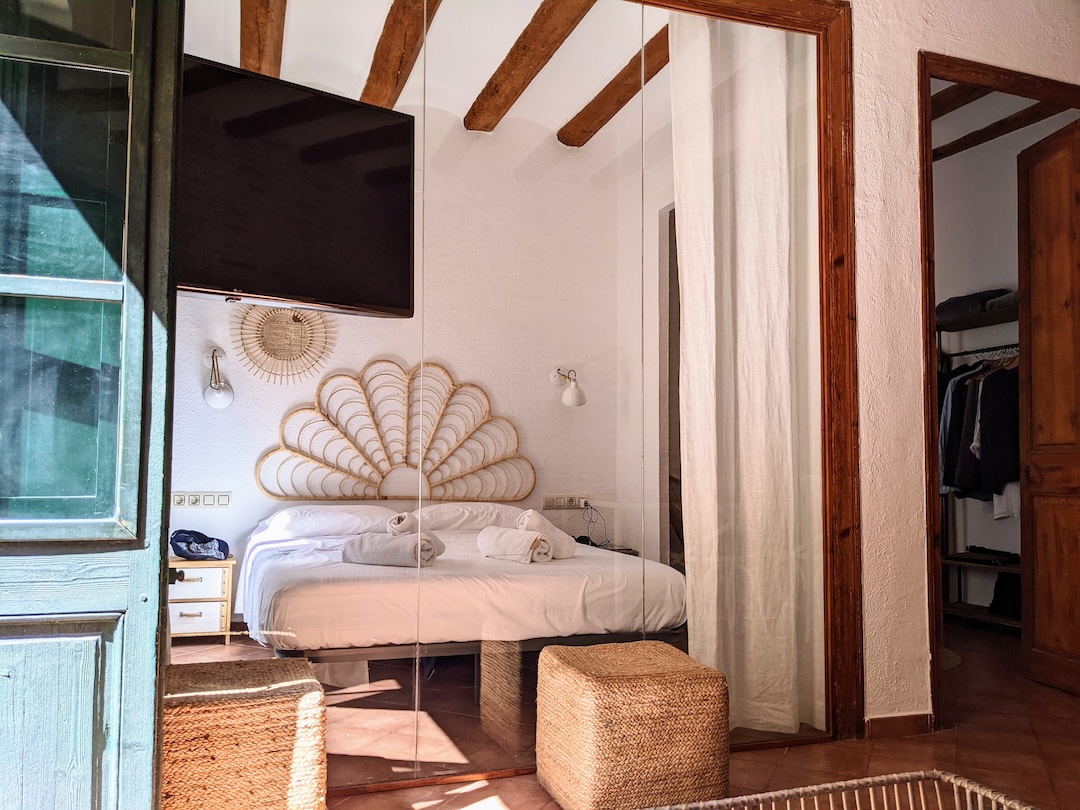
What We Paid: We rented a holiday apartment here for September and it came to €1,500 for the month. That’s off-season pricing — expect to pay considerably more in July and August — but it gives you a sense of what a longer stay actually costs.
Don’t Miss: The Via Ferrata Cala del Molí, a cabled climbing route along the cliffs just outside town. I absolutely loved it, and it’s the single best reason to base yourself here that no other guide seems to mention. You clip into a fixed cable and traverse the rock face right above the sea. There are operators in town who’ll take you if you’ve not done one before.
Best For: first-timers, families, off-season trips, anyone who wants a real town rather than a resort.
Check availability in Sant Feliu de Guíxols
S’Agaró and Platja de Sant Pol — the quiet one
S’Agaró is a short walk north along the coast from Sant Feliu and it’s one of my favourite spots on this whole coastline.
Platja de Sant Pol is a beautiful beach with very little built up around it — no wall of apartment blocks, no strip of bars. Instead, just a broad curve of sand. The walk there from Sant Feliu along the Camí de Ronda takes about 25–30 minutes and it’s easy, mostly flat and pretty the whole way.
S’Agaró itself is quiet, green and a bit exclusive — it’s a planned early-20th-century development of elegant houses rather than a village that grew up around a fishing harbour. The bay itself is lined with sleek fish restaurants and wine bars, but there’s not much in the way of nightlife or shops — which is exactly the point.
Best For: Couples, quiet beach days, anyone who wants Sant Feliu’s amenities a half-hour stroll away.
Check availability in S’Agaró
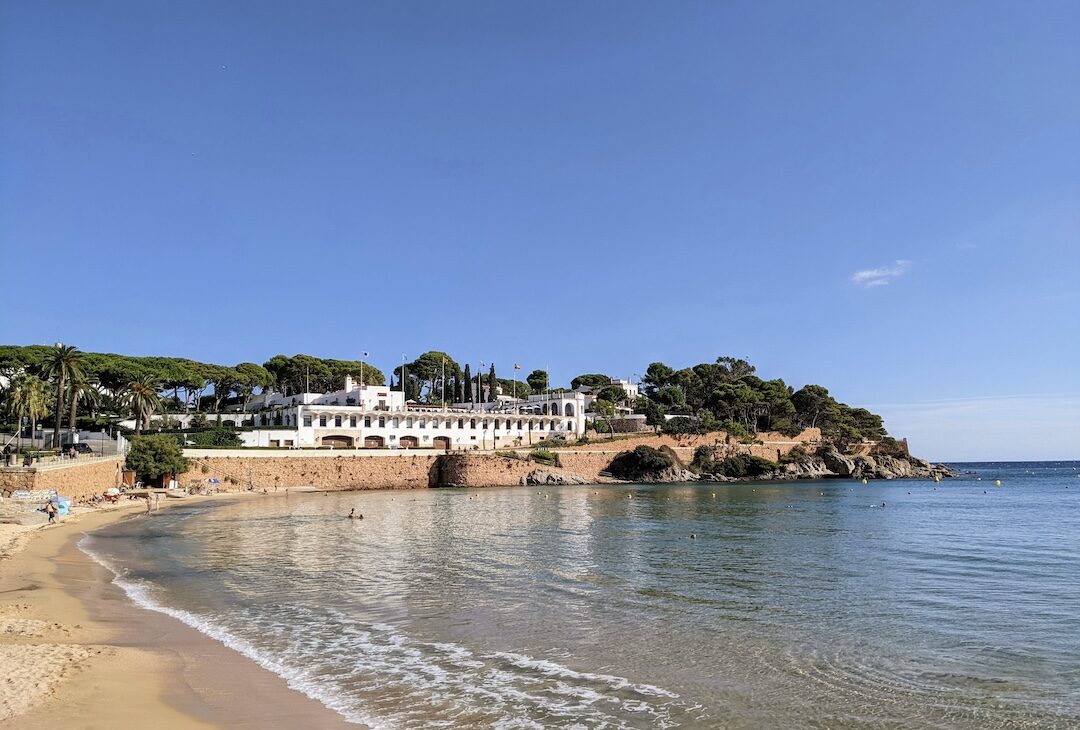
Calella de Palafrugell — the prettiest walkable base
If you want the classic Costa Brava postcard — whitewashed arches, fishing boats pulled up on the sand, tiny coves between rocky points — this is it.
Calella de Palafrugell is lovely, and it’s one of the very few places on this coast where you can arrive without a car and still reach several beaches and another two villages on foot. Of course, it gets busy in high summer, and the small coves fill up fast, but the setting earns it.
Just south of the village, the Cap Roig botanical gardens sit on a headland above the sea — clifftop gardens around a castle, and one of the nicest hours you can spend here that doesn’t involve a beach towel.
Best for: Couples, coastal walkers, photographers, car-free trips.
Check availability in Calella de Palafrugell
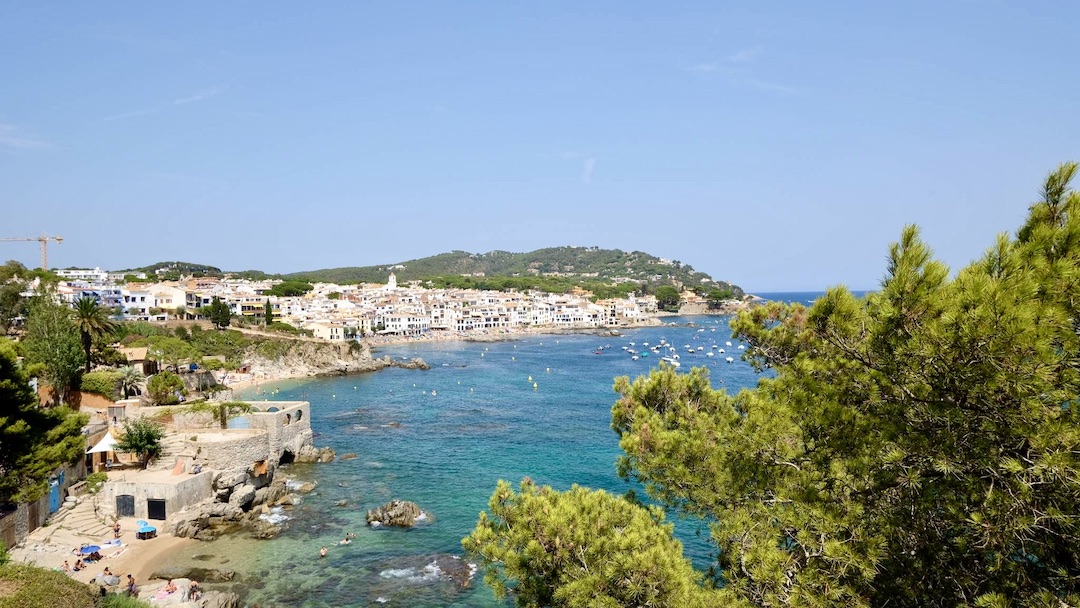
Llafranc — quieter, and a 25-minute walk away
Meanwhile, Llafranc sits just around the headland from Calella and has a wider, sandier, more swimmable bay with a proper promenade behind it. As a result, it feels slightly more polished and slightly less frantic.
In our case, we went down to Llafranc for the quieter beaches on that side of the coast, and it certainly delivered. The coastal path between Calella and Llafranc is under a kilometre and takes 20-30 minutes at a wander — one of the nicest short walks in Spain, and it means you can stay in either and use both.
Best for: Beach days, families who want sand rather than pebbles, easy walking
Check availability in Llafranc
Palafrugell — the inland town
Worth understanding the geography here, because it confuses people. Palafrugell is the inland town; Calella de Palafrugell, Llafranc and Tamariu are its three coastal villages, a few kilometres down towards the sea.
Palafrugell itself is a gorgeous little whitewashed town with a proper market and a real local life, and it gets seriously busy in summer. It’s cheaper than the coastal villages and has better bus connections, but you’re not walking to a beach from here.
Best For: Budget, market days, travellers with a car.
Check availability in Palafrugell
Tamariu — the smallest and calmest of the three
Finally, there is the third of the Palafrugell villages, and the least developed. A small cove backed by pines, a handful of restaurants, and not a great deal else — which is the appeal.
It’s the quietest of the three by some margin. The walk from Calella to Tamariu, via Llafranc and the Sant Sebastià lighthouse, is about 9km and takes roughly two hours along the coastal path.
Best for: Switching off completely
Check availability in Tamariu
Cadaqués — beautiful, but be realistic about getting there
I haven’t been, but my Spanish friends who live in Barcelona rave about it and it’s the one place on this coast they tell me I’ve got to see. Whitewashed buildings stacked around a bay, right up near the French border, and by all accounts absolutely beautiful. A little posh, too.
However, it’s the hardest place on this list to reach. It sits over a mountain pass on a winding road, roughly an hour from Figueres, and it’s a long way from everywhere else on the coast. Salvador Dalí’s house at Portlligat is next door and Cap de Creus, the wild headland at the far northeastern tip of Spain, is just beyond.
Base yourself here for the scenery, not for touring the rest of the Costa Brava.
Best for: A splurge, art and scenery, couples.
Check availability in Cadaqués
Begur — stunning town, but check the map before you book
Begur is up on a hill, crowned by a ruined castle, with views over the whole Empordà. It’s one of the prettiest towns on the coast and it’s on every list for good reason.
Here’s what those lists don’t tell you: Begur town has no beach. Its celebrated beaches — Aiguablava, Sa Riera, Sa Tuna, Platja Fonda — are all a drive down winding roads, and in summer you’ll be circling for parking. People book Begur imagining they’ll wander down to Sa Tuna after breakfast, and then discover it doesn’t work like that.
If you have a car and want a beautiful base with beaches nearby, Begur is excellent. If you don’t have a car, pick somewhere else.
Best for: Drivers, views, character.
Check availability in Begur
Girona — the inland base people forget
Although Girona isn’t on the coast, it’s better than most places that are.
We spent a full month living here in an apartment and loved it. Above all, it has a beautifully preserved medieval old town, a Jewish Quarter that’s one of the best surviving in Europe, city walls you can walk at sunset, and a food scene well beyond its size. It also has its own airport, an excellent train connection to Barcelona, and buses out to the coast.
The thing that made it work as a base: it’s much calmer in August than the coast. Everyone piles down to Sant Feliu de Guíxols and the Costa Brava beaches, and Girona stays liveable. You get a proper city on your doorstep, and you can be on a beach in an hour when you want one.
It’s also the obvious answer if it rains, or if you want somewhere with life in it in the off-season when the coastal towns wind down.
👉 Read my full Girona travel guide for what to do, where to eat and where to stay.
Best for: Car-free trips, August, culture, longer stays, families who want a base with substance.
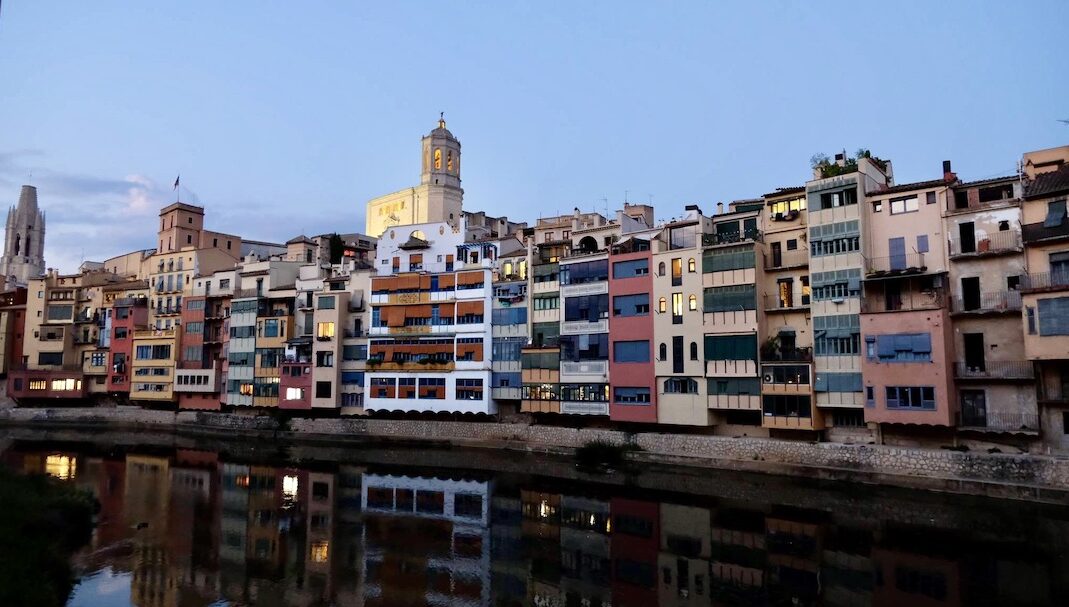
Palamós and Sant Antoni de Calonge — mid-range
I spent time in Sant Antoni de Calonge, mostly because I was climbing at Rocòdrom 9C just along the front in Palamós — the two towns run into each other along the seafront.
It’s not especially pretty. The seafront is long and fairly ordinary, with a lot of apartment blocks behind it. That said, it’s pleasant enough — there are loads of cafés and bakeries, the beach is long and sandy, and it’s noticeably cheaper than the postcard villages up the coast.
If your budget doesn’t stretch to Calella de Palafrugell and you don’t mind trading looks for value and space, it’s a reasonable call. Palamós also has a proper fishing port and is known for its prawns.
Best for: Budget, longer beach days, indoor climbers.
Check availability in Palamós
Pals and Peratallada — for a night inland
Two medieval stone villages a few kilometres inland, both beautifully preserved and both extremely photogenic. In fact, Peratallada is one of the best-preserved medieval villages in Catalonia.
They’re wonderful to visit and make a lovely night or two if you’re driving, but they’re not beach bases — you’ll be twenty minutes or more from the sea, and you’ll need the car for everything.
Best For: A romantic night inland, drivers.
Check availability in Pals and Peratallada
Where I Wouldn’t Stay on the Costa Brava
Picking the wrong town here really can shape your whole week. For that reason, these are the Brits abroad, resort-y towns I would personally avoid in the Costa Brava.
Platja d’Aro
This is the one I’d most want to warn people about, partly because it looks perfectly fine on a map — it’s right next to S’Agaró and Sant Feliu, on the same lovely stretch of coast.
It’s over-touristy in a way the neighbouring towns simply aren’t. The seafront is lined with fun parks and theme-park style attractions aimed at kids, it’s very busy, and it has none of the character of Sant Feliu twenty minutes down the road. Platja Gran is a decent beach underneath all of it, and there’s good coffee in town, but I wouldn’t sleep here.
Stay in Sant Feliu de Guíxols or S’Agaró instead — same coastline, completely different holiday.
Tossa de Mar
Tossa has an impressive walled medieval old town on the headland, and it’s worth a day trip to see it. The town around it is package-holiday territory — resort hotels, crowds, and the kind of seafront that could be anywhere on the Spanish coast. Come for the Vila Vella. Don’t book a week here.
Lloret de Mar
The best-known name on the Costa Brava and the least representative of it. Lloret is mass-tourism, nightlife-driven, and if you’ve pictured pine-covered coves and whitewashed fishing villages, this is the opposite of that.
Blanes — a maybe
Blanes marks the southern start of the Costa Brava and it’s the easiest town on the whole coast to reach without a car. It’s the one place with a direct train from Barcelona. It has a good long beach and the Marimurtra botanical gardens on the headland are lovely. However, it’s a big, fairly developed resort town.
Walking Between the Costa Brava Towns
The Camí de Ronda is an old coastal path — originally a smugglers’ and coastguards’ route — that runs along much of this coastline, now largely following the GR 92. It connects a lot of the villages, and it means “which town do I stay in” matters slightly less than you’d think, because you can walk between several of them. In fact, we walked long stretches of it and it was one of the best things we did on this coast.
| Route | Distance | Time |
|---|---|---|
| Sant Feliu de Guíxols → Platja de Sant Pol (S’Agaró) | ~2km | 25–30 mins |
| Calella de Palafrugell → Llafranc | Under 1km | 20–30 mins |
| Llafranc → Sant Sebastià lighthouse | — | ~30 mins uphill |
| Calella de Palafrugell → Tamariu (via Llafranc) | 9km | ~2 hrs |
| Tossa de Mar → Sant Feliu de Guíxols | ~22km | Full day |
Finally, two practical notes. It’s rocky and uneven in places, with a lot of steps. It is not a buggy or wheelchair route, and not one for flip-flops. There’s very little shade on some stretches, so in July and August go early or late.
How Many Days Do You Need on the Costa Brava?
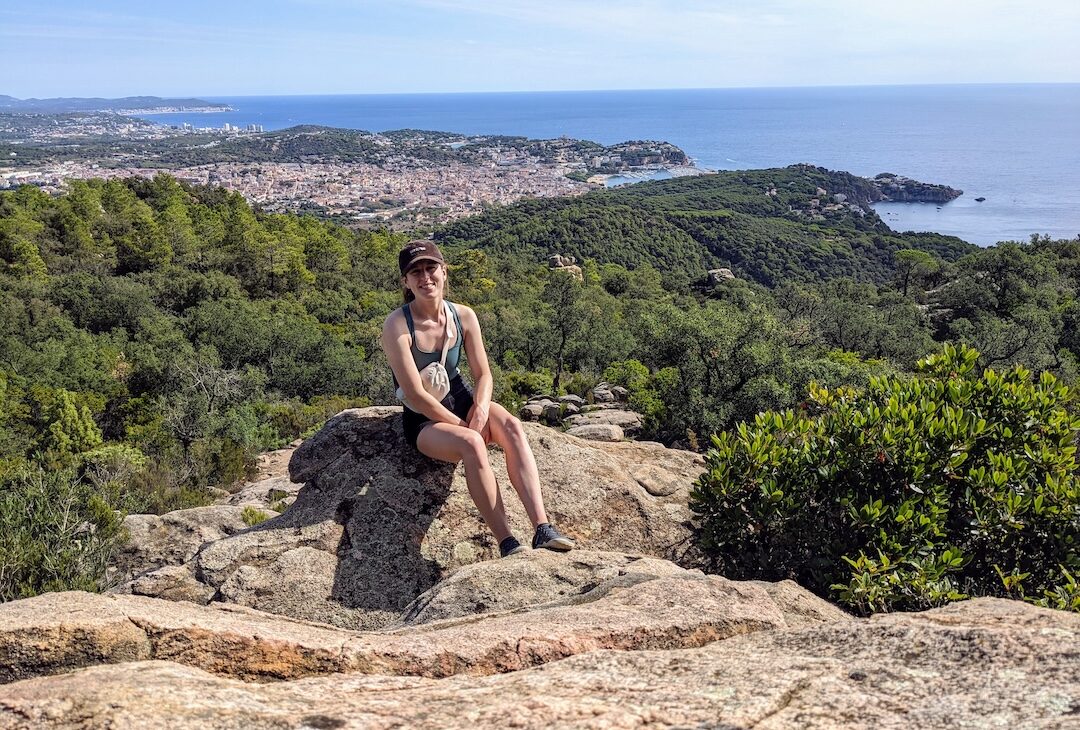
Four to five days is about right for a first trip, and you could easily do a week without repeating yourself. Two or three nights works if you’re tacking it onto Barcelona, but you’ll only really see one section of the coast.
If you’ve got a week and no car, I’d split it: three or four nights in Sant Feliu de Guíxols or Calella de Palafrugell for the coast, then two or three in Girona for the city, food and a change of pace.
Where to Stay on the Costa Brava FAQs
What Is the Best Area to Stay on the Costa Brava?
Sant Feliu de Guíxols if you want one base for the whole coast, because it has the buses, the shops and a working town around it. Calella de Palafrugell if you want the prettiest walkable version and you do not mind paying for it. Girona if you would rather be inland with the trains, and Cadaqués only if you have a car and time.
What Are the Best Places to Stay on the Costa Brava for a Quiet Trip?
S’Agaró and Platja de Sant Pol, Tamariu, and Llafranc out of season. All three are small, none of them has a strip, and Tamariu in particular is the calmest of the three Palafrugell coves. Skip Lloret de Mar, Tossa de Mar and Platja d’Aro if quiet is what you are after.
Are Costa Brava Hotels Expensive?
It depends heavily on which town and which month. The Palafrugell coves, Begur and Cadaqués are the priciest in July and August, while Palamós, Sant Antoni de Calonge and Sant Feliu de Guíxols are noticeably cheaper for the same stretch of coast. Shoulder season in May, June and September brings prices down across the board. Check the map above for live rates.
More Spain and Where-to-Stay Guides
- Girona Travel Guide: Things To Do and Where To Stay
- 3 Days in Barcelona
- Spain’s Best Cities
- Sóller & Port de Sóller, Mallorca: Where to Stay and What to Do
- Where to Stay in Ibiza: Best Areas, Villages and Villas
- Where to Stay in Malta: Best Areas to Base Yourself