

Why is everyone wearing Trader Joe’s tote bags?
I bought four Trader Joe’s tote bags in Boston. The classic big cream canvas one with the navy straps and the red logo. One for me, and three as gifts for my mum, my mother-in-law and my sister-in-law.
They were $4.99 each. A great value souvenir.
Just as I got back home, the Telegraph called the Trader Joe’s tote “London’s saddest status symbol.” In January, the Guardian asked whether it’s the last vestige of American soft power. Both are scathing about the tote and the people carrying it.
I think the bag is misunderstood, so here is my defence of the Trader Joe’s tote bag.
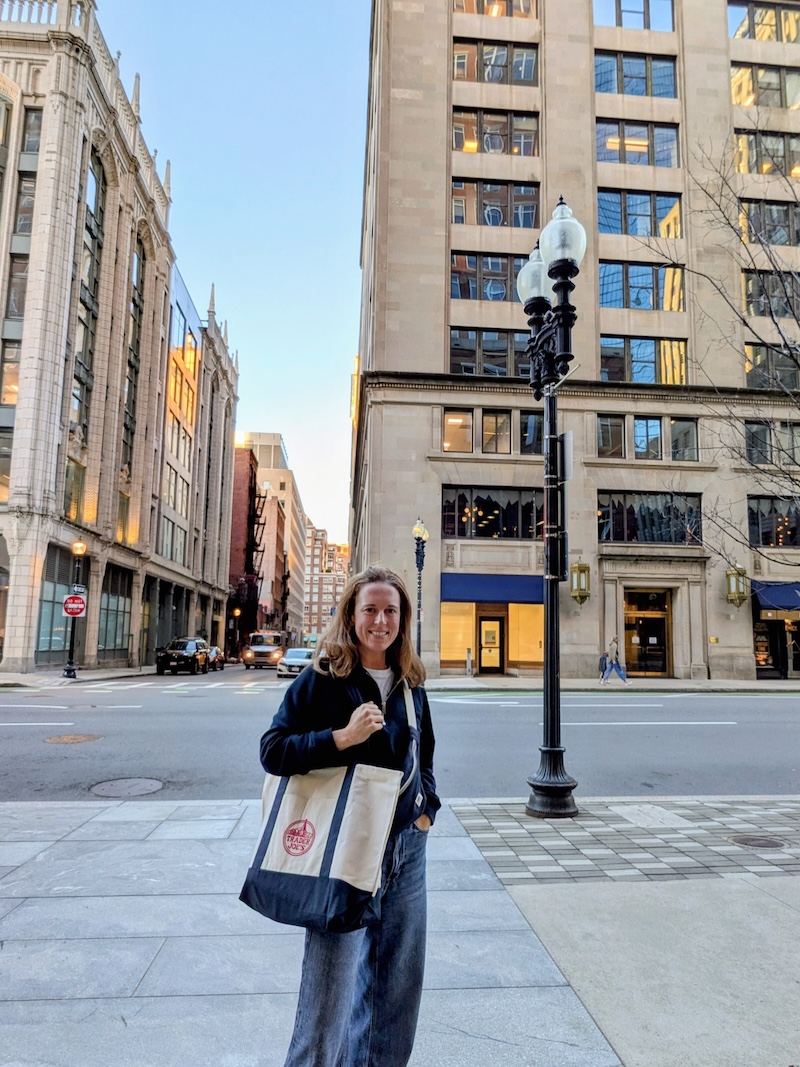
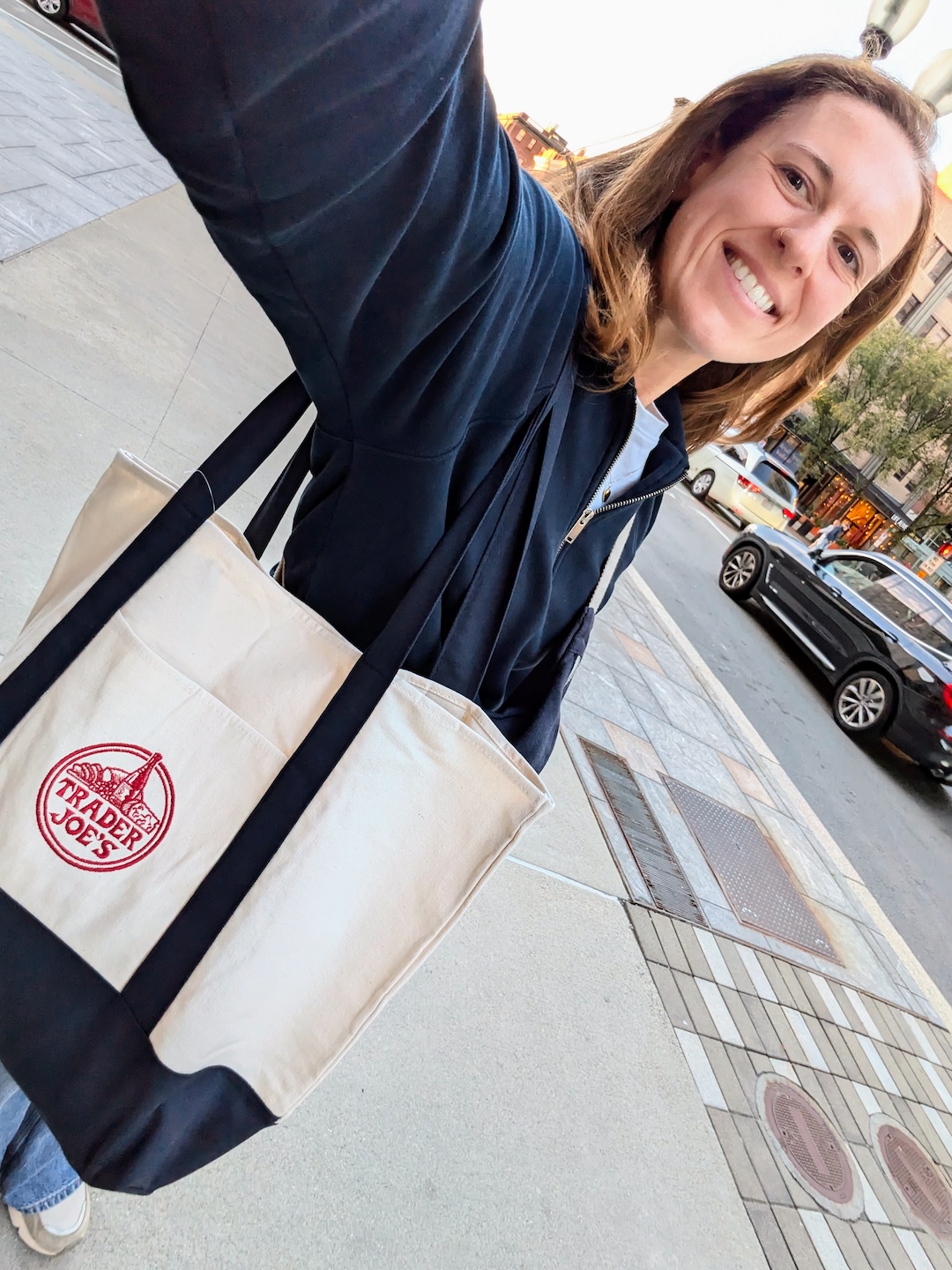
What a Trader Joe’s tote bag is
Trader Joe’s is an American supermarket chain. The first store opened in Pasadena in 1967 and there are now more than 650 of them across 43 states. There are no Trader Joe’s stores in the UK. This is a full-on American supermarket brand.
The tote bag everyone is arguing about is on the shoulder of the ‘cool girls’ in London, and I’ve recently spotted a few down here on the south coast in Brighton.
There are a bunch of versions. The navy/cream one is the classic, but there’s a whole load of minis in pastel colours. Slightly embarrassingly, I checked three stores for the minis in Boston, but only the classic totes were around.
I also wasn’t the only British woman buying this tote bag: the woman ahead of me was buying fourteen of them to take home for friends who’d requested one. These totes are popular!
Why is everyone wearing Trader Joe’s tote bags? What the British newspapers say
Dave Schilling wrote a sort-of satirical Guardian piece, saying that Trader Joe’s isn’t worth the fuss, and that if you want a tote bag you should fly to Los Angeles and buy one there, because the city could use the tourism. He also admits to bringing a Waitrose bag home from London for exactly the same reason I brought this one back from Boston — proof he’d travelled there — but unfortunately no one complimented him on it.
Imogen Woodberry’s Telegraph piece is harsher. She compares Londoners carrying Trader Joe’s totes to Soviet teenagers queuing for McDonald’s and coveting Levi’s in 1989. Her argument is that American consumer culture has become exotic to us because Britain has got poorer, and the bag is a small sad symbol of that which less well-off girls are carrying. Not to mention she thinks the bags are “neither particularly luxurious nor especially beautiful.”
Newspapers are saying Trader Joe’s totes are selling for $50,000. It’s in the Guardian piece, it’s in Forbes, it’s all over American news sites.
I went looking for where it came from. It starts with a Substack post in January, which says listings on eBay and Korea’s Karrot market reach $10,000, with some touching $50,000. Listings. Not sales. Nobody has shown that a single person has ever paid it.
On eBay UK the large canvas totes go for £5 to £9. On Vinted, they’re around £7.
It’s awkward for Schilling, because his argument is that people would rather spend $50,000 on a bag than visit America. They wouldn’t. They’re spending seven quid.
My mum asked for one and she hasn’t read any of this
I WhatsApped my mum a photo of me in Boston with the tote bag over my shoulder. She messaged back to say she loved the bag and could she have one.
My mum is not a Trader Joe’s fan. She’s been to America twice, the last time about five years ago when I took her to New York for her birthday. To her, it’s a supermarket. She hadn’t read the Telegraph piece or the Guardian one. She isn’t in Hackney or Peckham and isn’t playing the London status game. She just liked the bag.
Take the trend away, take London away, take the newspaper columns away, and my mum still wants the bag. And, you know what? I like it too.
Why is a cheap trend “sad” and an expensive one isn’t?
The Marc Jacobs canvas tote is £225 at full price. It’s a cotton bag with the brand’s name printed across the front. Longchamp’s Le Pliage is £125 and it’s nylon. A Goyard Saint Louis starts at around £1,350, and that’s canvas too.
Nobody has written a broadsheet essay about any of them being sad.
A Trader Joe’s tote is $4.99, which is about £4. It is the same object ultimately. The only thing that’s really different is the price, and what the price indicates about the brand and person carrying it. The cheapest one is the only one anybody calls pathetic.
Woodberry’s article literally says it. She pictures a graphic designer in Camberwell on £30,000 spending half her post-tax salary on a room in a flatshare. The bag is only sad because she’s skint. That isn’t a criticism of the bag. It’s a criticism of someone’s socio-economic status.
We pay hundreds of pounds for designer polyester, and thousands for a polyester wedding dress. Why have I never seen a newspaper call that sad?
Trader Joe’s built a brand, our UK supermarkets built a price war
I would not be seen carrying a Walmart bag. I wouldn’t carry an Aldi bag either, and Aldi is what makes this funny, because Trader Joe’s and Aldi are related.
The Albrecht brothers split their German business in 1961 and have been legally separate since 1966. Theo Albrecht bought Trader Joe’s in 1979. Today Trader Joe’s sits under Albrecht family ownership with Aldi Nord as a sister company, while Aldi Süd runs the Aldi stores you see here in the UK and the ones in the US.
Trader Joe’s does almost no paid advertising. It has no loyalty card. It stocks around 4,000 products where a normal supermarket stocks 40,000, and about 85% of them are own brand. Its marketing is a comic-style newsletter called the Fearless Flyer, Hawaiian shirts on the staff and products that people tell their friends about.
Now look at ours. Aldi’s current UK campaign is called Can’t Match This and it’s built on price comparisons against Tesco and Sainsbury’s. Waitrose cut prices on more than 370 products this month in a £20 million push and put it on billboards. The day before the Telegraph ran a piece about British decline, Waitrose was advertising that it’s cheaper than you think.
None of our supermarkets are cool. They’re all racing each other to be the cheapest, and none of them are actually cheap, because the cost of living here is what it is. That’s a branding problem, and it’s our problem, not America’s.
I had a soft spot for Trader Joe’s before it turned up in London. The first time I went to the States, I visited a British friend who was studying at Stanford Uni. Neither of us had any money. We went to Trader Joe’s and bought Two Buck Chuck, their famously cheap own-brand wine. The bag brings back that nostalgia for me.
The shop was built for the exact person the Telegraph is pitying
Joe Coulombe opened the first Trader Joe’s in Pasadena in 1967. He said it was for “overeducated and underpaid people, for classical musicians, museum curators and journalists.” He put the stores near universities on purpose.
The graphic designer in Camberwell on £30,000 who has been to America and come back with a tote bag isn’t a symptom of British decline. She’s the target customer. She has been since 1967, when America was at the top of its game.
But to me, there’s a second association for the Trader Joe’s tote.
The ‘granola girl’ America, and why British women want it
Trader Joe’s doesn’t stand for the America we get shown on TV. It isn’t drive-throughs and enormous portions. It’s lavash bread, dark chocolate sunflower seed butter cups, granola, trail mix, own-brand everything, and someone loading it into the boot before a hike.
We don’t have that image here. There is no British version of the “granola girl.” We don’t have national parks or mountains on the scale that the US does and we don’t have the culture that comes with them.
Why shouldn’t British women want that side of America? Wanting to be the person who drives to a trailhead with good snacks in the back isn’t a sad aspiration. It’s a nice one. The bag is the closest shorthand we’ve got for it, and it shows our support for the side of America that isn’t the stereotyped TV standard.
Boston was one of the friendliest places I’ve been
I was in Boston for three days for work. People stopped me in cafes and shops to talk. Not to sell me anything, just to chat, and it happened again and again.
Several of them brought up politics unprompted. They wanted me to know that not everyone there thinks the way the news makes it look, and that America isn’t the stereotype we get on TV. I hadn’t asked, and I was glad they wanted to share with me.
Most British coverage of America at the moment is about Trump and it’s overwhelmingly negative. Trader Joe’s isn’t that America. Carrying the bag isn’t cheering for the current administration, and I’d say it’s closer to the opposite. I don’t think many Republicans are walking round Hackney with a Trader Joe’s tote on their shoulder.
The brand doesn’t belong to the America that’s been exported to us lately, the one that’s all fast food chains, enormous portions and suspicion of anywhere foreign. It belongs to the other one. Outdoorsy, health-conscious, well travelled. That’s a cultural leaning rather than specifically party politics, but there is something mildly political in this in my opinion.

Where to buy a Trader Joe’s tote bag in the UK
There are no Trader Joe’s in the UK, and the company doesn’t sell online at all, so there’s no official way to buy one here.
Your options are eBay UK and Vinted, where they’re around £7, or asking someone who’s going to America. Or you could visit the US, though I wouldn’t do so just to get a TJ tote bag as that does make it exorbitantly expensive.
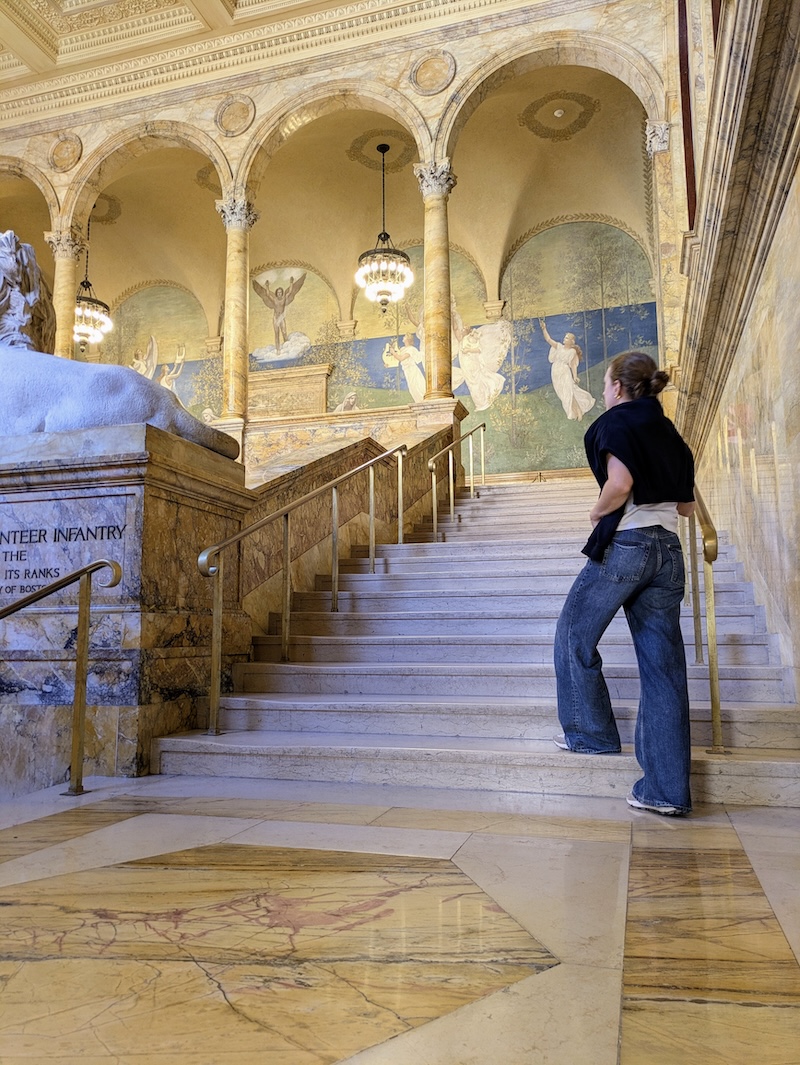
If you’re thinking about the USA and want a friendly city, I highly recommend Boston. I’ve written a guide to where to stay in Boston plus one day in Boston and a weekend in Boston. And there are plenty of Trader Joe’s across the city.
If you’re in Brighton or London, you’ll see me around with my TJ tote, Waitrose shopping and ‘granola girl’ snacks.