
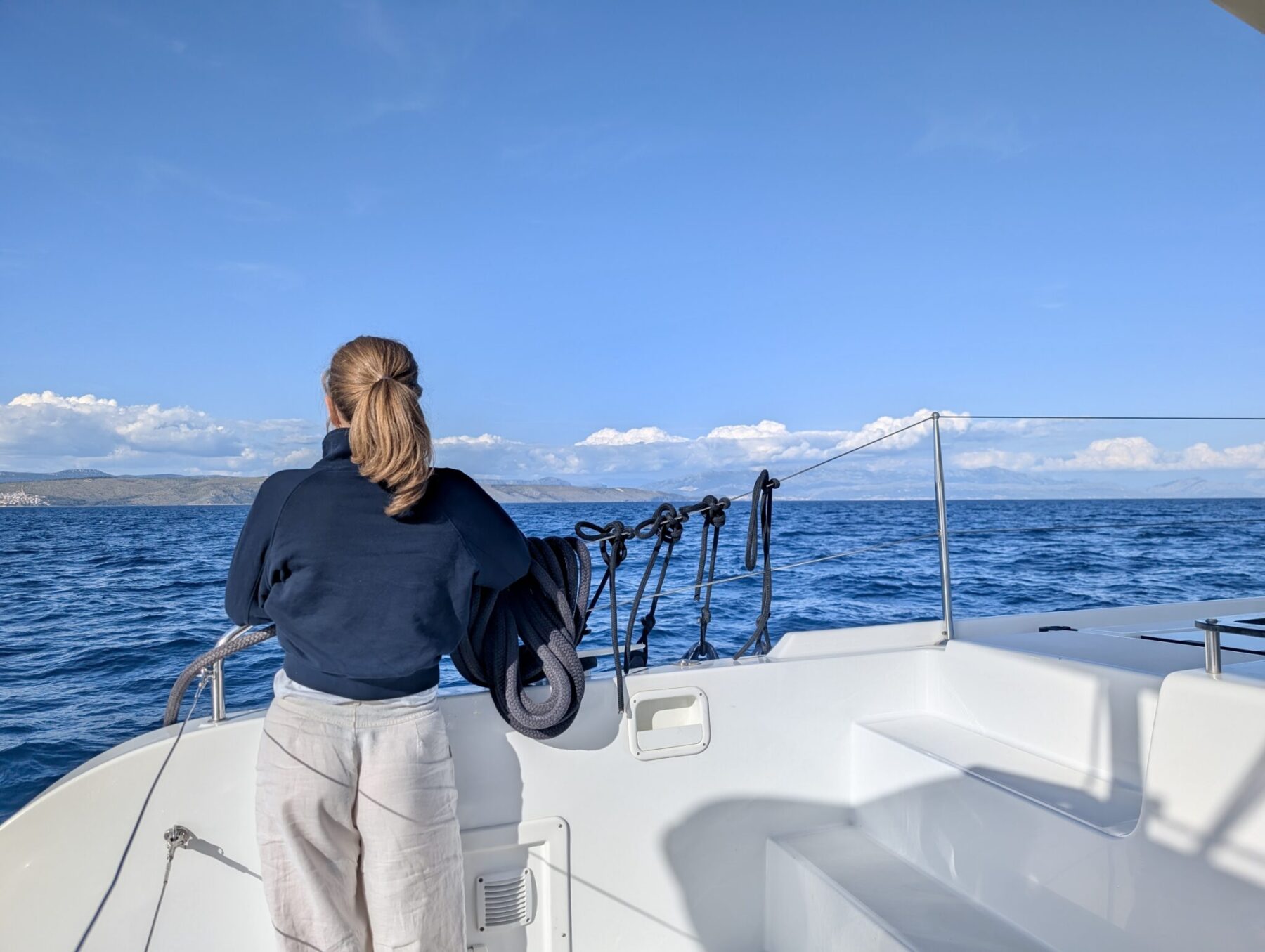

Sailing the Croatian islands by yacht or catamaran is one of the best ways to experience the Dalmatian Coast. Board a catamaran in Trogir, slip from island to island on your own schedule, and sleep on the water. Reach quiet bays, dive in the waters at pine-fringed anchorages and explore the tiny harbour towns that make this stretch of the Adriatic worth visiting.
We’ve been pulled back to Croatia time and time again by the beautiful coastline and island hopping adventures. The classic Croatian bay, a pebbly outcrop, shaded with pines, overlooking glass-clear water, is a sophisticated alternative to your typical European beach. And what better way to reach these bays, and have them all to yourself, than with a sailing trip?
We sailed in early May, before the high-season crowds arrive on the islands, and crossed between the islands of Šolta and Hvar with More Sailing, a sailing operator chartering Croatian island sailing trips from Trogir. What follows is a day-by-day account, written for anyone considering a Croatia catamaran cruise of their own, plus a practical info section covering costs, packing tips, and FAQs.
In this guide
Why Catamaran Sailing in Croatia is Better than a Yacht
Let’s break down catamarans vs yachts before we go any further!
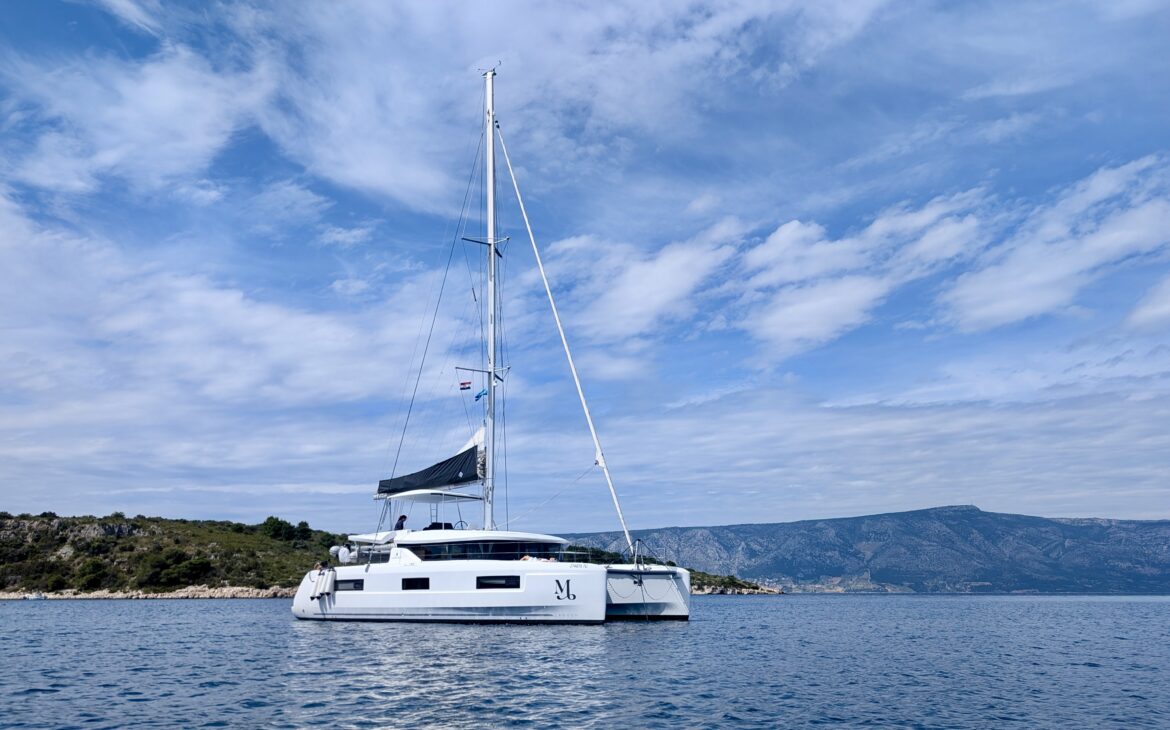
A catamaran has twin hulls that sit flatter on the water than a typical monohull yacht. In practice, this means a catamaran has less rocking with the waves, more sunbathing space, and a much better chance your less nautical friends will still be speaking to you on Day 3 (and not leaning over the edge of the boar feeling sea sick!)
Many people initially looking for a ‘yacht’ trip, may really prefer sailing on a catamaran for these reasons. Catamaran sailing in Croatia equally gives you the ability to slip into a bay where there’s nothing but a couple of stone houses and a dusty path, drop anchor, swim off the back of the boat, and then sail on by lunchtime.
It’s no surprise boat holidays in Croatia have boomed in the last five years and that “sail Croatia” is one of the most searched travel phrases in the UK for the Adriatic. The supply has finally caught up with the demand, and a cabin charter is now one of the more affordable ways onto the water.
There are three options for sailing in Croatia: bareboat hire (you sail it yourself, licence required), private charter (the whole boat is yours), or a cabin charter with a captain. This trip falls firmly in the third camp, which is also the most sociable and most affordable of the three. You don’t need a sailing licence. You don’t need to cook. You don’t need to make decisions about anchorages. You just need to remember one rule: beer and wine start at lunch.
Why We Sailed Rather Than Took Ferries
You can reach Šolta and Hvar by ferry from Split, if you wanted to. So why charter?
- You sleep on the water. Mooring up in a quiet bay at sunset, swimming off the back of the boat in the morning before anyone else is awake and enjoying peace on the sea. That’s the bit you can’t buy a ferry ticket for.
- The route is yours. If a bay is full, the next one is 20 minutes away. If a wind picks up, you re-route. Ferries run on a fixed timetable to fixed harbours, so freedom is limited.
- The bays you actually want to swim in are sail-only. The Croatian islands have many bays that are only accessible by boat, or very small gravel roads on land.
- Costs flatten when you split it. A yacht for 4 nights split between 6 friends offer an affordable alternative if you would like to be on the sea.
Our honest take: if you can only do one Croatian island and you need to keep costs down, take the ferry to Hvar. If you want the best experience possible and to island hop, go sailing by yacht or catamaran.
Our 4-Day Sailing Trip Itinerary
Our 4-day Croatian sailing trip route was planned by our wonderful skipper, Zoe. When you join a sailing trip in Croatia, you don’t have to worry about the route. The skipper decides the best route based on the wind, weather and their local knowledge of the islands, harbours and bays.
The Route at a Glance
Trogir → Šolta → Hvar → Šolta → Trogir. Roughly 60 nautical miles over four days, all of it in protected mid-Dalmatian waters with short hops between islands. Each leg is a day sailing with lunch in a quiet, hidden bay and anchorage in bays and small town harbours.
| Day | From → To | Sleep |
|---|---|---|
| 1 | Board in Trogir → Šolta | Quiet bay in Šolta |
| 2 | Šolta → Hvar (Jelsa) | Jelsa harbour |
| 3 | Hvar (Jelsa) → Šolta (Maslinica) | Maslinica harbour |
| 4 | Šolta (Maslinica) → Trogir | Trogir marina |
Day 1: Split airport → Trogir → Šolta
We were picked up at Split airport by two smiling twenty-somethings in gleaming More Sailing polo shirts, bottles of Diet Coke protruding from their back pockets. Within minutes, one of them informed us she had the best job in the world and seemed to mean it.
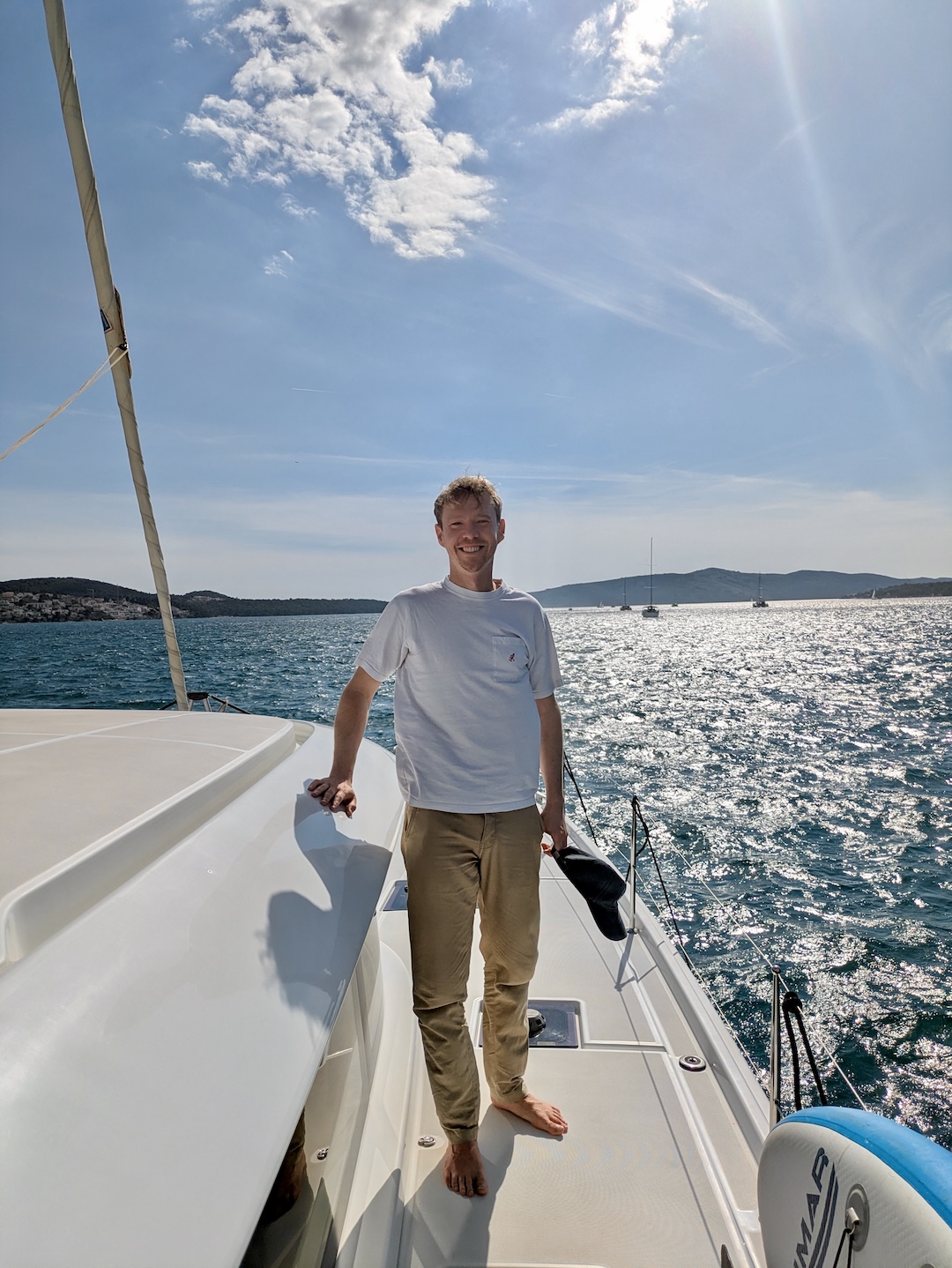
From Split airport, it’s a 15-minute drive down to the marina at Trogir, which is where most More Sailing trips begin. At the marina we met Zoe and Linus, our captain and host for the trip. Young, impressively tanned, and very blonde, they introduced us to what would be our home for the next three days: Coolway. The catamaran was all gleaming white surfaces and soft edges.
We shared the boat with three other couples, making ten people in total including the crew. Zoe mentioned there were a couple of spare rooms at the stern, and we had to look blankly around for someone to explain that this meant “front”. Our cabin had a bed for two, a sea view, just enough storage space for our bags, and, to our delight, a private shower and toilet.
Back on deck, we met the other guests and sipped white wine while listening first to the safety briefing and then the plan for the day’s sailing. Of particular importance was the “11 o’clock rule”: alcohol consumption before 11am was (not unreasonably) forbidden. We were headed for Šolta, the nearest sizeable island to Split, where we would anchor overnight in a sheltered bay.
Then we were off, gliding out into smooth seas and leaving the mainland behind. We spent the afternoon beneath clear blue May skies, swapping travel stories with our charming new companions. In a pleasing reversal of traditional gender roles, it transpired that Linus was our host and chef, and Zoe was our skipper, so Linus busied himself preparing dinner while Zoe took the helm.
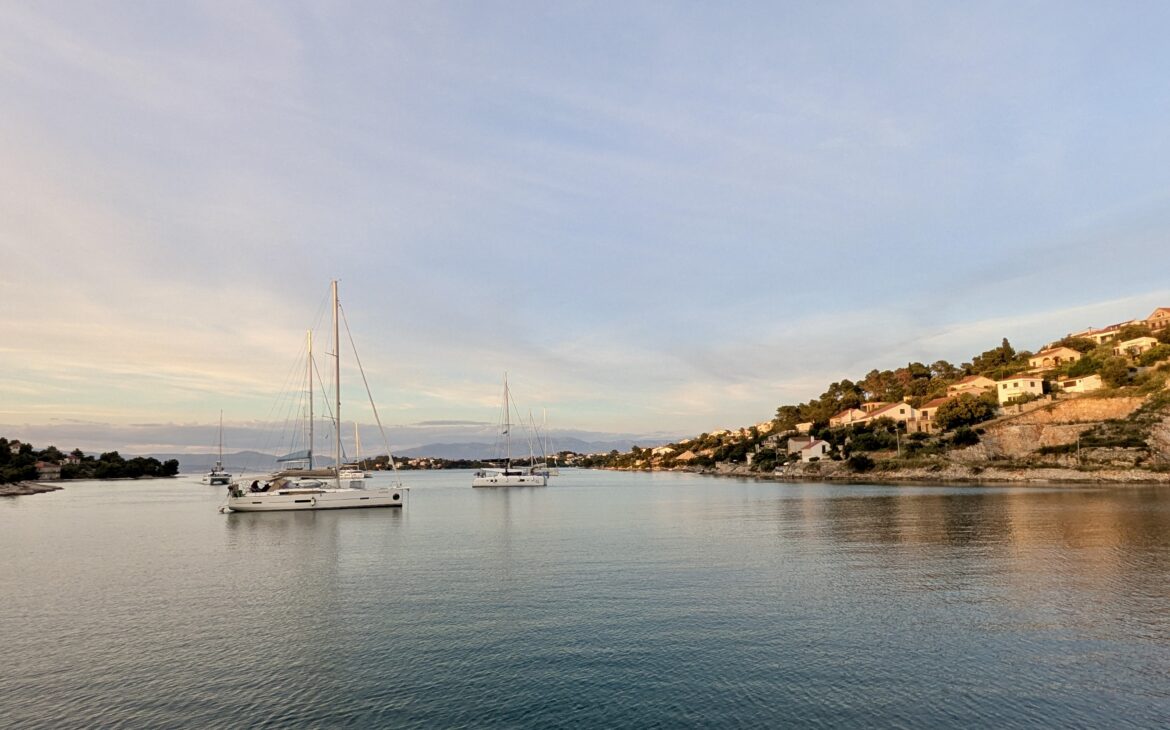
Just before sunset we entered a deep bay on the island of Šolta. A dozen or so boats sat at anchor, a scattering of houses lined the shore, and pine scented the evening breeze. Then, somehow, despite my (Luke’s) complete lack of nautical competence, Zoe announced we could take the dinghy ashore. I was entrusted, after a twenty-second tutorial, was leading an expedition to land.
Things began poorly when I pulled the stop cord rather than the starter cord. We drifted helplessly for several minutes, unable to restart the engine, before sheepishly paddling back to the catamaran. Zoe restarted the motor for us and we set off again, completing a triumphant lap of the bay. My companions, having witnessed my earlier performance, tactfully suggested we avoid turning the engine off again under any circumstances.
After a brief exploration we returned to our catamaran just in time for dinner. Linus served a charcuterie spread of cheeses, fruit, breads, hummus, tomatoes, feta, peaches, and artichokes, all arranged with artistic flourish. We ate together as the light shifted from gold to purple and finally to black.
Day 2: Šolta → Hvar (Jelsa)
I slept soundly, dreaming of dolphins, and woke fully rested to birdsong on the shore. A glass panel beneath the stairs allowed us to peer at shoals of fish resting in the clear blue water beneath the hull. After a warm-ish shower we climbed up on deck just in time to watch two carefree skinny-dippers leap into the water from the neighbouring boat.
Breakfast was cinnamon porridge, boiled eggs, bread, fruit, vegetables, cheese, nuts, and instant coffee. Zoe raised the anchor and we set off for Hvar, waving to the other boats as we passed.
We passed the morning learning more about sailing from Zoe: the difference between port and starboard, knots and miles-per-hour. She’d been sailing since the age of six, though this was just her second season as skipper of a charter of this size. With an enviable lack of over-thinking, her career plans went simply to the end of summer and no further, except for an understandable desire not to spend the winter in Sweden.
By midday we had reached a bay on the north side of Hvar, even more isolated than the previous night’s anchorage. The hills around us were thick with pine forest and broken only occasionally by the old stone building or small jetty disappearing into the water.
Having learned from the previous evening’s mechanical humiliations, we elected not to risk the dinghy and instead took out the stand-up paddle board. Charlie and I drifted lazily around the bay, occasionally swapping paddling duties. The Adriatic in May is not warm, but with the sun out and beating down upon us, we seized the moment and swam, very momentarily, to cool down.
Back onboard, Linus had produced another excellent lunch. There was falafel, couscous, warm bread, hummus, and ajvar spread generously across soft white cheese. Ajvar, our favourite discovery from an earlier trip around Macedonia, is a smoky spread of roasted red pepper and aubergine that seems to improve almost anything it touches.
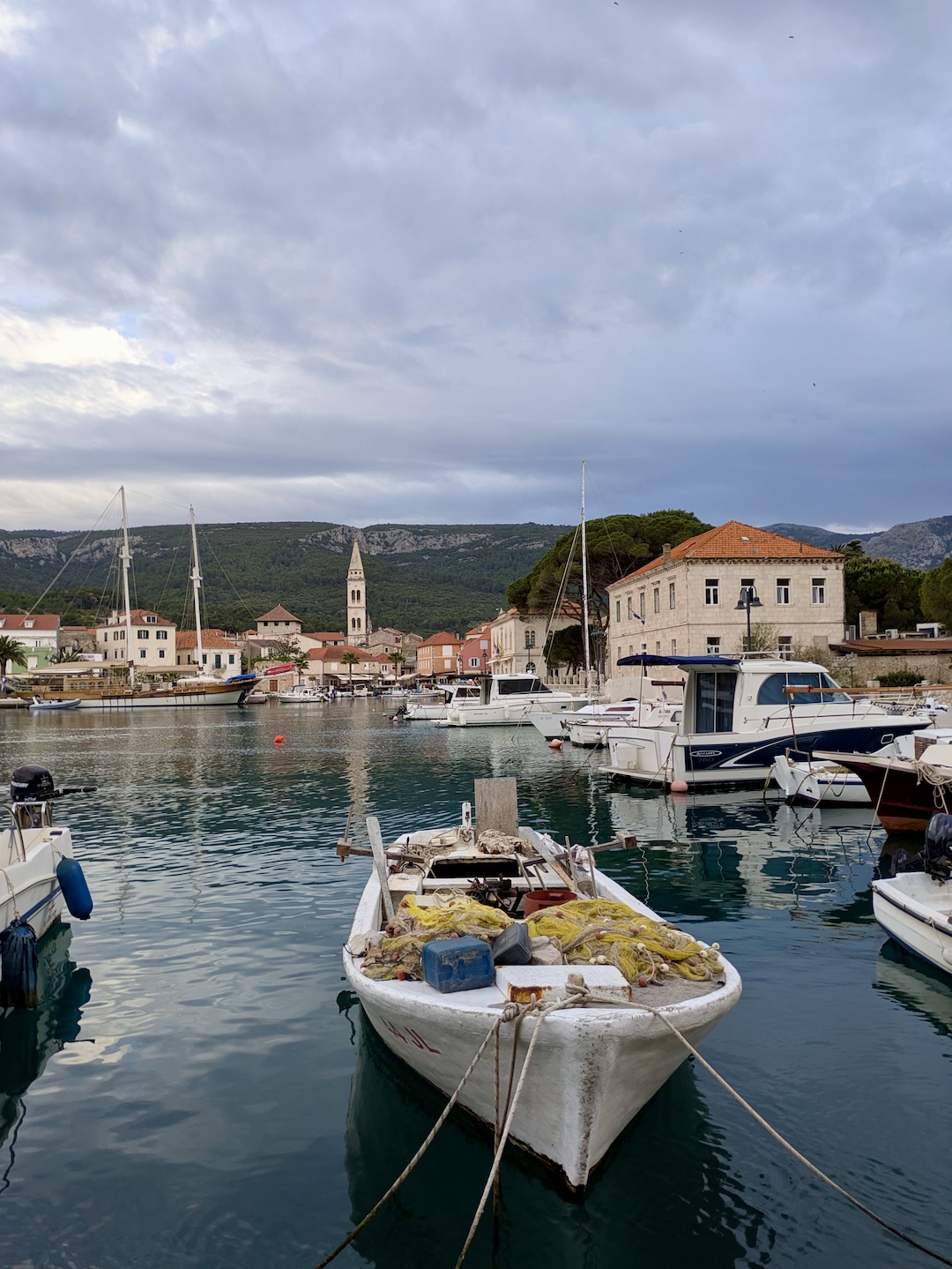
Arriving in Jelsa: After lunch we raised anchor once again and sailed for Jelsa, a small harbour town on the northern side of Hvar. People who know Hvar only by its reputation for beach clubs, DJs, and yacht parties may not realise how large and varied the island actually is. The famous nightlife is centred around Hvar Town and reaches its peak in midsummer. Jelsa, by contrast, felt relaxed, very quiet and wholesome in May. If you’re researching where to go on Hvar with smaller children, Jelsa is a strong choice.
The town was all polished stone streets, church towers, shuttered windows, and fishing boats rocking gently in the marina. We made straight for a café in pursuit of our first proper coffee in over twenty-four hours. We wandered along the waterfront afterwards.
That evening we ate at a waterfront restaurant, Spizza, recommended by Linus and Zoe. I was delighted to find truffle pasta on the menu. Hvar lies relatively close to Istria, which I know from a previous trip does fantastic truffles and excellent handmade pasta, and the meal fully justified the decision.
Later, back onboard, we drank wine and played cards with the other guests while dark clouds slowly gathered over the harbour. A storm had been forecast, but the bay around Jelsa was well sheltered. Safe inside the marina, we fell asleep to the cosy sound of rain tapping against the boat.
Where to Stay in Jelsa
If you’re not sleeping on board, the Jelsa area has a handful of lovely places to stay. From a family-friendly resort in next-door Vrboska to a couple of pretty spots in the town itself. Three I’d look at first:
Aminess Senses Resort
Polished four-star resort just outside Jelsa (in Vrboska) with pools, sea views and easy beach access.
Check ratesHotel Hvar
Classic three-star on Jelsa bay with two pools, a spa and the cafés and stone alleys on your doorstep.
Check ratesVilla Vista Hvar
Apartment-style stay in Jelsa with stellar reviews. Walkable to the harbour, ideal for couples and small groups.
Check ratesDay 3: Hvar (Jelsa) → Šolta (Maslinica)
Charlie and I were first up, and this posed a challenge we hadn’t anticipated. The wooden plank connecting the catamaran to the shore had been pulled in overnight, so we had to redeploy it. We plonked it down and approximated a sailor’s knot to hold it in position. Would it hold? We held our breath and dashed across to dry land, making it across in one piece.
Despite the early hour, a couple of cafés were already opening for locals stopping in for bread and coffee before work. After two strong espressos, we set off for a short coastal stroll before breakfast.
Breakfast (cinnamon oats, boiled eggs, bread, soft cheese and vegetables) was served as, for the first time, we headed into choppy waters. Zoe called the unsettled waves “old sea”, explaining they were left over from strong winds earlier in the week.
So far none of us had suffered from seasickness, helped no doubt by the relative stability of the catamaran’s twin hulls, but we still gratefully accepted Linus’s offer of seasickness gum as a precaution.
As if apologising for the rougher waters, the Adriatic rewarded us with something unexpected: dolphins. A pod surfaced a few hundred metres from the boat, their dark fins rising and falling in smooth arcs across the water before vanishing again beneath the waves. For a few minutes conversation stopped entirely as all of us stood watching them.
By midday we had arrived in a deep bay on the southern side of Šolta and slipped back into our now familiar rhythm of reading, sunbathing, swimming, and paddle boarding. Meanwhile, Linus disappeared into the galley for several hours and emerged with lunch: creamy gnocchi with chilli and mushrooms, alongside a sharp fennel and lemon salad.
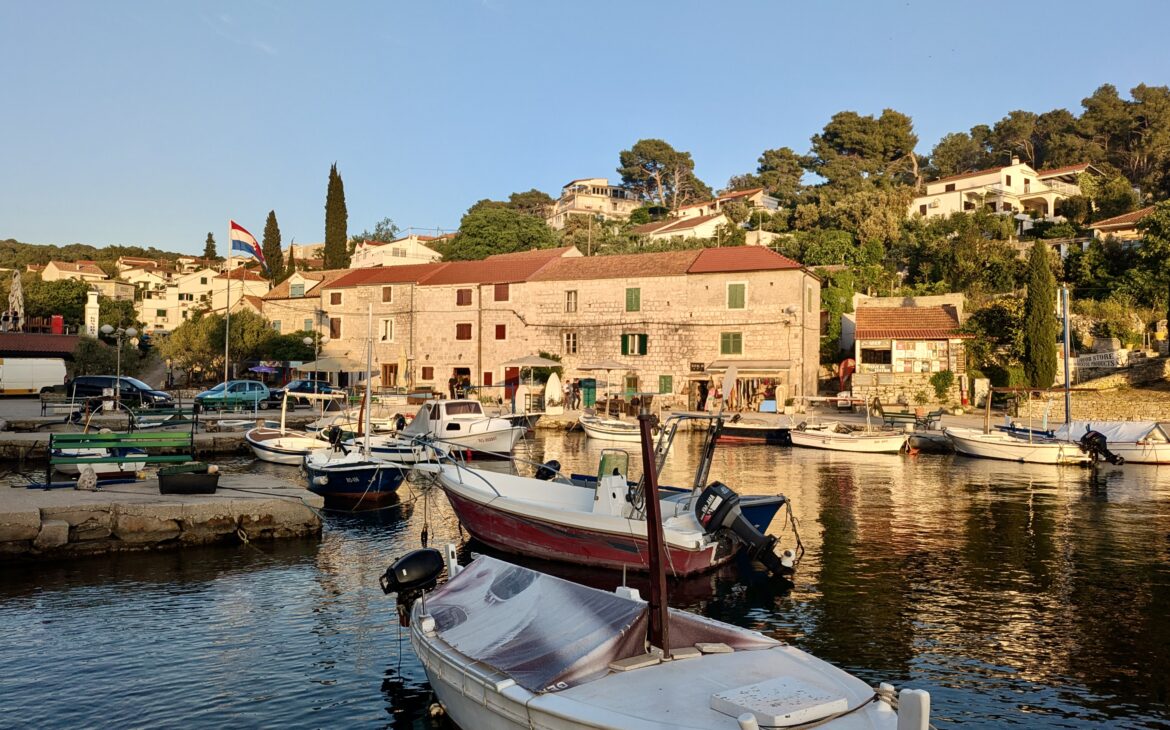
Our final stop was Maslinica, a small town on Šolta known for its eighteenth-century castle and gleaming white-stone marina. The name derives from the Croatian word for olive tree, and the hills surrounding the harbour were thick with olive groves divided by old dry-stone walls. We spent the evening eating in one of the harbour restaurants and catching the sunset from our boat.
Day 4: Šolta (Maslinica)
Unlike the other guests, we would not be returning to Trogir and Split. Instead, we were staying on Šolta for a few more days of quiet island life.
Reluctantly, it was time to say goodbye to our new friends. We carried our luggage ashore, exchanged hugs and promises to stay in touch, and then stood on the harbour watching Coolway drift slowly out towards the open water, bound once again for Trogir marina where the other guests would spend a final night on the boat.
Where to Stay in Maslinica
Maslinica is a small, single curving harbour ringed by stone houses. There are only a handful of places to stay, but the ones that exist are good. We stayed at and loved Sol Melba.
Sol MELBA Boutique Studios
Sea-view boutique studios just back from Maslinica harbour. Beautifully reviewed (9.9/10), free parking, EV charger on site.
Check ratesMartinis Marchi Heritage Hotel
18th-century castle on the waterfront with seven suites and a Michelin-recommended restaurant. The grand splurge.
Check ratesVilla Lemony
Four-star apartment-style stay with a pool, walking distance to the harbour and castle. Great for families.
Check ratesA Few Takeaways After Three Days at Sea
The pace is the point. If you’re someone who wants a packed itinerary, this isn’t it. You’ll sail for a few hours, anchor, swim, eat, sail again. The total daily step count is small. The reward is feeling a sense of adventure and life that’s completely different to “normal”.
Catamarans suit nervous sailors. The twin hulls mean far less heeling than a monohull yacht. I’m normally the first to get motion sick, but with just the one piece of gum I felt fine. Two or three of our party did look worse for wear on the stretch to Maslinica, but I’m confident things would’ve been a lot worse on a typical yacht.
The crew matters more than the boat. Linus’s cooking turned every meal into an event. Zoe was a patient, funny teacher. A different captain and host could have produced an identical itinerary and a completely different experience.
It was more luxurious than we expected, but it’s not a five-star hotel, and that’s fine. The shower is short. The coffee is instant. The cabins are small. None of this is a problem unless you’ve come expecting a superyacht. What you’re paying for is access to bays and anchorages most travellers never see, and stunning views of the Croatian islands from the water.
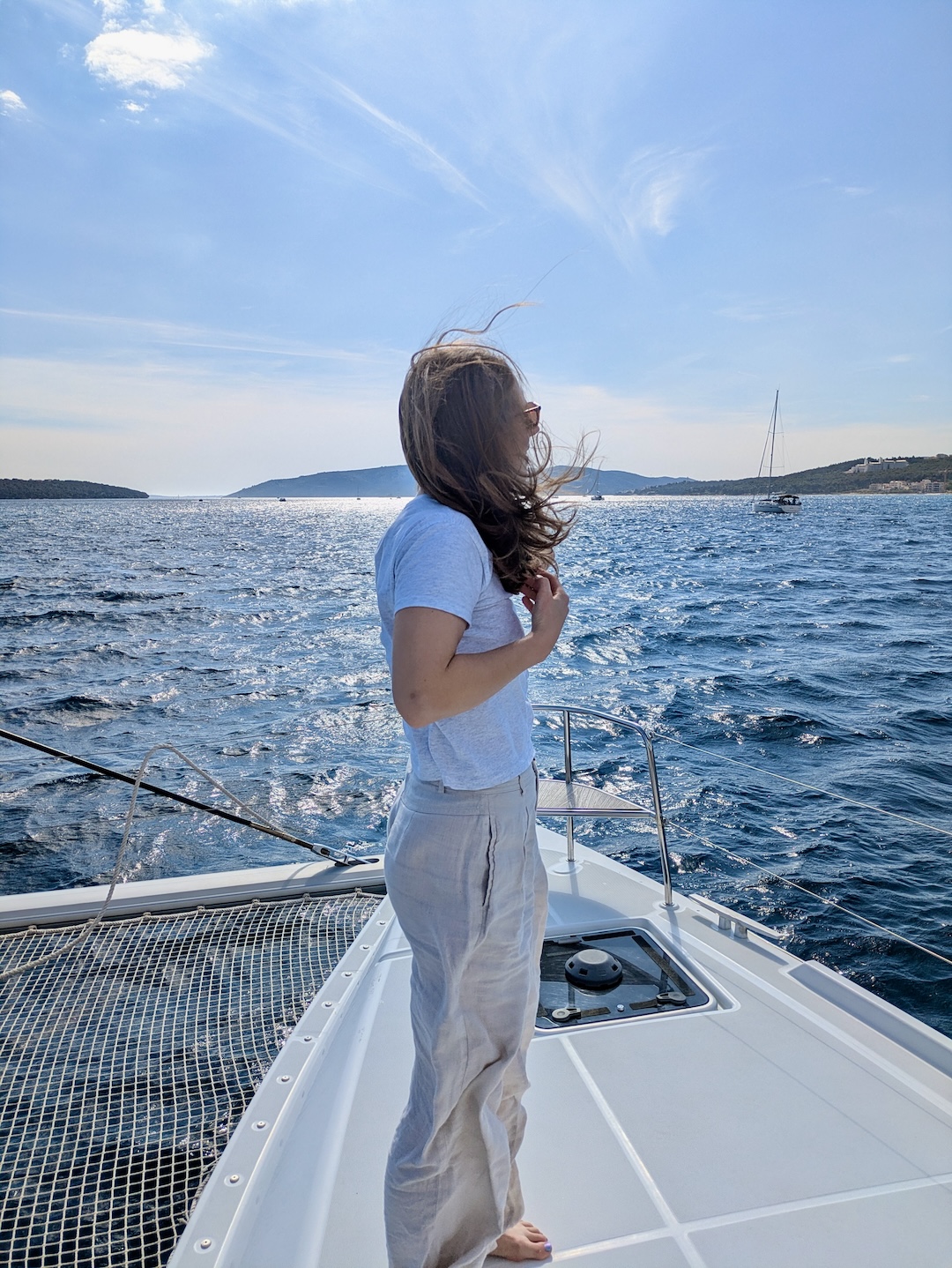
Practical Info: Planning Your Own Croatia Sailing Trip
Who Runs the Sailing Trips
More Sailing operates small-group cabin charters from Trogir, on the mainland just north of Split. A typical trip is seven nights. Boats sleep eight to ten guests across three or four cabins, plus two crew. Solo cabins, couples, and small groups of friends are all common.
Sailing Trip Costs
Cabin charter prices vary by boat, season and route, but as a rough UK-buyer rule of thumb: expect to pay roughly £1,200 to £2,200 per person for an eight-day cruise, including food, water and skipper. Use our discount code charlie5 to get 5% off your sailing trip. Prices tend to be higher during peak season from June-August. The shoulder seasons of May, September and October offer a more affordable time of year to visit.
Best Time To Go Sailing
The season runs from May to October. May’s weather was changeable: we had both sunburn and rainstorms. July and August are hotter and busier, with higher prices and more crowds, but excellent swimming. Shoulder seasons of May, September and October offer less crowds, but the weather isn’t guaranteed.
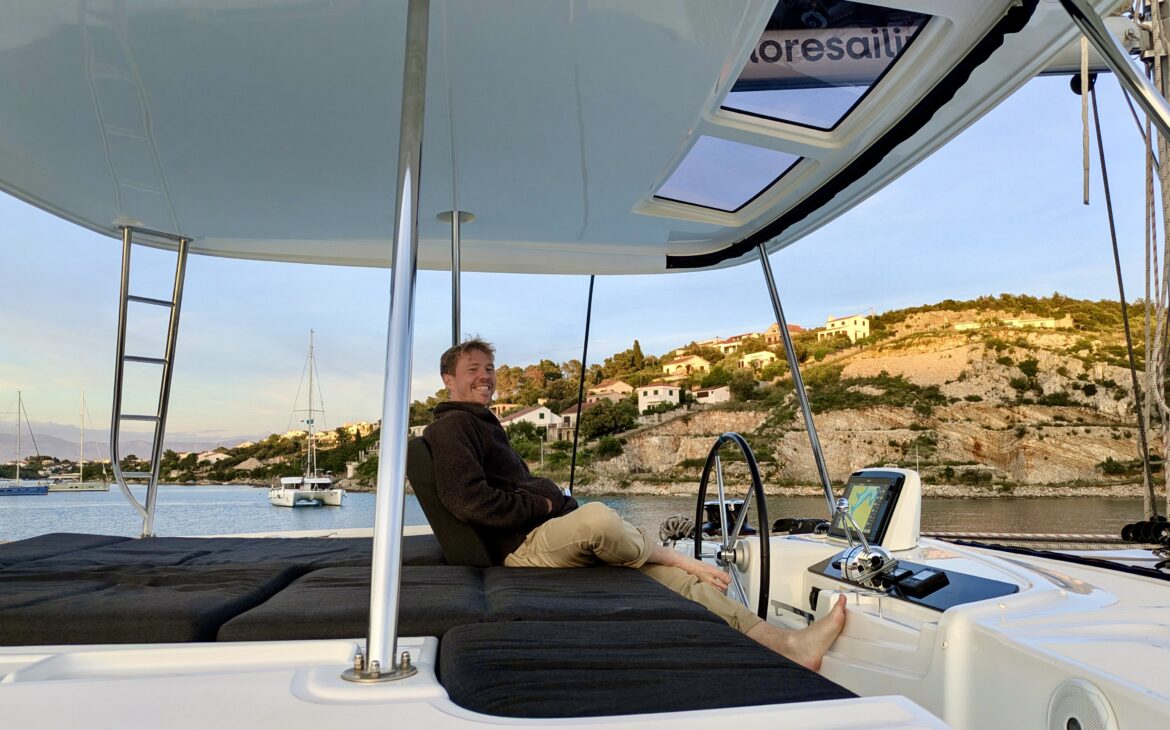
Where You’ll Sail
If you’re looking at islands near Split specifically, a typical Trogir-based itinerary will touch some combination of:
- Šolta — the closest big island to Split. Quiet bays, pine forest, olive groves and the village of Maslinica.
- Brač — famous for the shape-shifting beach at Bol.
- Hvar — large and varied. Hvar Town for nightlife, Jelsa and Stari Grad for slower harbour-town vibes.
- Vis — further out and popular during peak season, with the Blue Cave on neighbouring Biševo.
This is classic Croatia island hopping territory and most cabin charters route through at least two or three of these stops.
What to Pack for a Croatia Sailing Trip
- A soft duffel bag or backpack, rather than a hard suitcase. Cabins are small and hard cases don’t fit anywhere. You’ll have more space if using a good backpack.
- Sunscreen. Sun reflects off the water, so you’ll burn quicker than on land.
- Swimsuit.
- A light jacket. Evenings on the water are cooler than you’d expect, even in July. It’s best to have a wind breaker.
- Fleece or warm jumper. In May, this was absolutely necessary due to wind chill and cooler evenings.
- USB charger. During sailing and when not docked in a harbour, you can charge devices by USB but not any other plug type.
- A waterproof phone pouch. Useful if you want to take photos from the dinghy or paddle board.
- Kindle. You’ll have lots of quiet time for reading during the sailing. Pack a Kindle with a few good books already downloaded.
- Fresh coffee bags. If you’re anything like us and need a decent cuppa in the morning, we’d recommend bringing some decent coffee along.
- Cards and cash. Most konobas (restaurants) take card, but some smaller places don’t. There are ATMs in some harbours including Jelsa and Maslinica. We brought cash with us for tips.
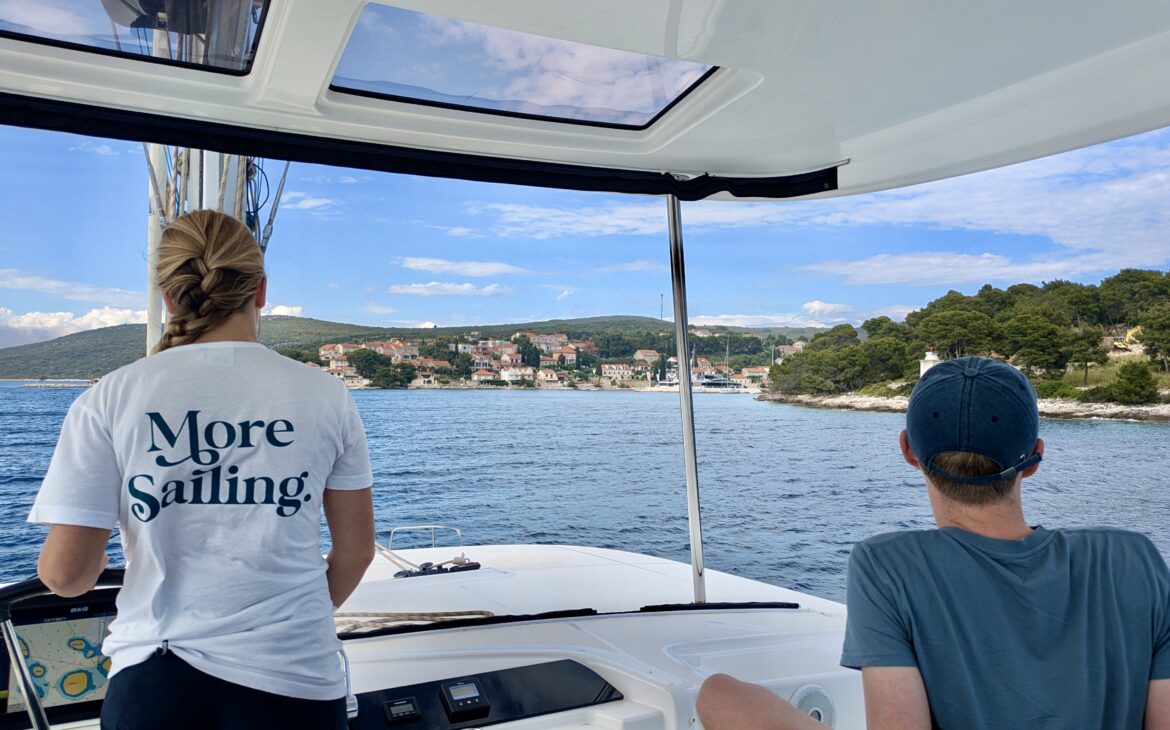
Croatia Sailing & Island Hopping FAQ
Yes, if you have a week and a group! The Dalmatian islands are very well set up for sailing (sheltered waters, short hops, dense network of bays and small harbours), and the version of Croatia you experience by yacht or catarmaran is meaningfully different from the ferry-and-hotel version. If you love being on the sea, you’ll love a sailing trip like this. Use code charlie5 at checkout for 5% off your booking with More Sailing.
Yes. Cabin charters with a captain are explicitly designed for people with no sailing experience. You don’t need a licence, you don’t help sail unless you want to, and the crew handles everything from navigation to anchoring to cooking. A catamaran in particular is the gentlest option for nervous sailors.
June is the sweet spot with sea temperatures around 20°C, islands not yet busy, harbours with space, reliable afternoon wind, prices below peak. September is the other shoulder, with the warmest sea of the year. July and August are hot, busy and expensive, so tend to require advanced bookings.
Bareboat charter means you hire the boat itself and sail it yourself — you’ll need a skipper’s licence (or you can pay extra for a captain). Cabin charter, like this trip, means you book a cabin on a shared boat.
You’re far less likely to get seasick on a catamaran than on a monohull yacht. The twin hulls dramatically reduce heeling and side-to-side motion. May to September seas are usually calm, especially in the morning. Bring seasickness gum, tablets, or wristbands just in case.
Three nights is enough to feel the rhythm of life onboard and visit two or three islands. A week is an epic adventure if you can spare the time, as it lets you reach further-out islands like Vis and Korčula, and you’ll properly decompress.
Absolutely. Jelsa and Stari Grad, the quieter towns on the northern side of Hvar, are some of the most charming harbour towns on the Dalmatian coast in May, June and September. You get the same sunshine, half the crowds, and lower prices.
We tipped 100 euros for our three nights, which we placed in an envelope and gave to Linus and Zoe on our last day. They looked a little surprised, but not unhappy!
English. More Sailing is a Swedish company and the staff are mostly Swedish, but speak perfect English.
We sailed with More Sailing and would highly recommend them for skippered sailing holidays in Croatia. They also run sailing trips in Greece, Italy, Sweden and the Caribbean.
- Booking a sailing trip? Use code charlie5 at checkout on More Sailing to get 5% off your booking.
- Planning a Croatia trip? Read our Croatia islands overview.
- Watch our Croatia Sailing Instagram highlight for more details on this trip.
We were kindly invited by More Sailing as guests on this trip. They covered the cost of the sailing trip in exchange for an honest write-up. All opinions, dinghy mishaps and overuse of ajvar are entirely our own.