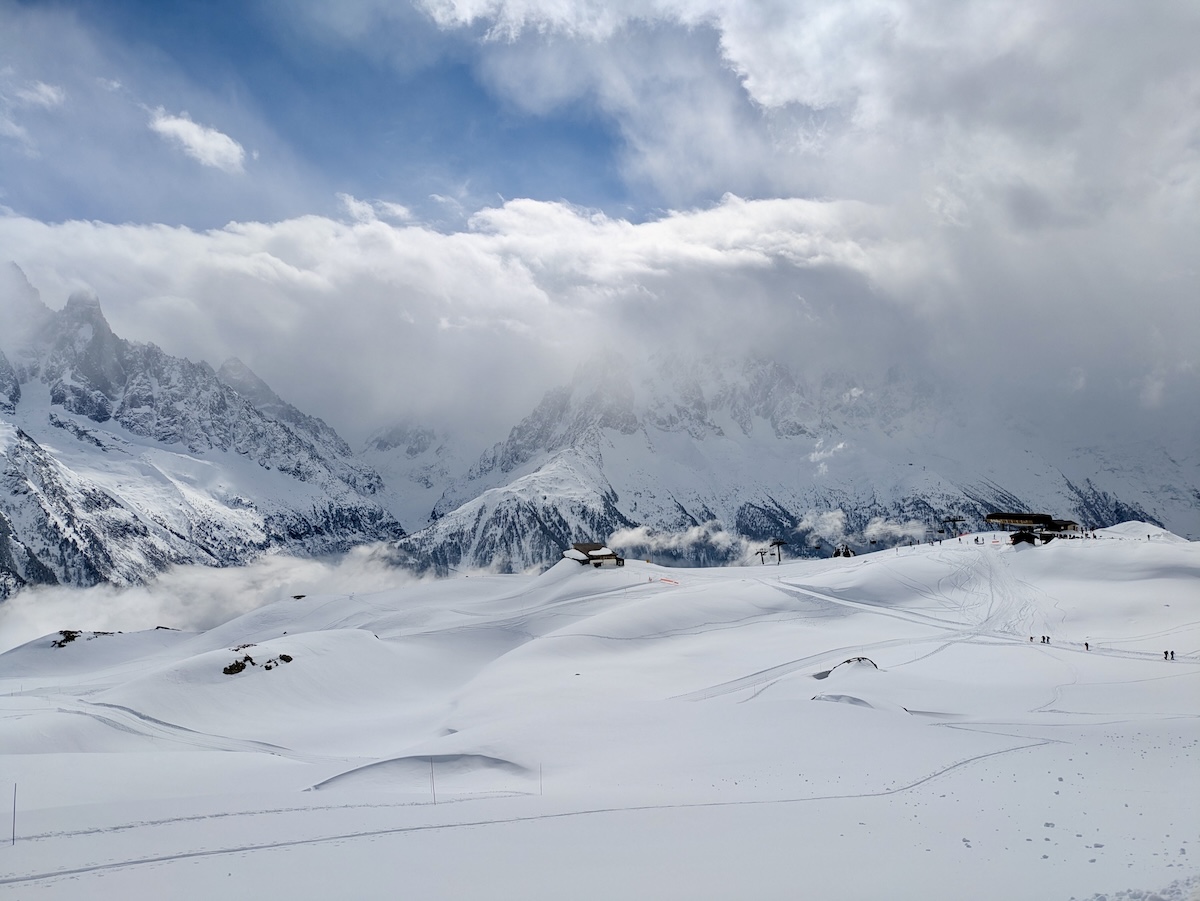

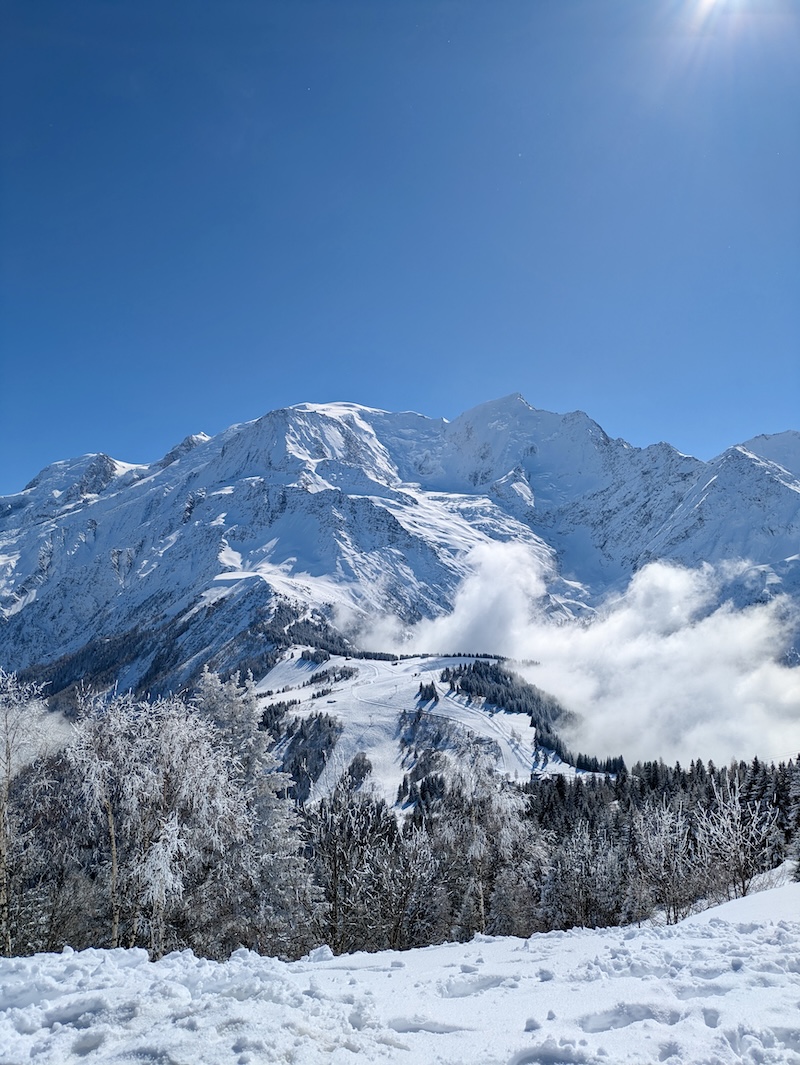
Chamonix skiing is renowned the world over — and for good reason. Nestled beneath the towering peak of Mont Blanc, this legendary resort blends world-class slopes with a distinctly French flair. Whether you’re carving through fresh powder, indulging in hearty Savoyard cuisine, or unwinding in a steaming spa as snowflakes drift down, Chamonix delivers an unforgettable ski experience.
Chamonix is not one ski area, though — it’s a valley of them, spread across 17km. Here’s how to make the most of a three day winter ski escape in the heart of the French Alps.
If you’re looking at the other half of the year, we’ve also written about Chamonix in summer.
In a Rush? Our Favourite Hotels in Chamonix
Hameau Albert 1er
5-star Relais & Châteaux with Michelin-starred dining, a mountain pool and breathtaking Mont Blanc views. The finest hotel in Chamonix.
Check ratesHôtel Mont-Blanc
A classic 4-star landmark right in the heart of Chamonix, with elegant rooms, a pool and consistently top ratings.
Check ratesLes Grands Montets Hotel & Spa
A 4-star spa hotel at the foot of the Grands Montets glacier, with a pool, wellness facilities and direct access to some of the valley’s best trails.
Check ratesIs Chamonix Good for Skiing?
Yes, Chamonix is fantastic for skiing, but it rewards confident skiers more than nervous ones. Chamonix’s reputation is built on steep, high, serious terrain: the Vallée Blanche off the Aiguille du Midi, the off-piste below Grands Montets, the World Cup black at Les Houches. If that’s what you’re after, few places in the Alps come close.
What Chamonix isn’t is a tidy, ski-in ski-out circuit. The areas are separate, you’ll spend time on buses or in a car between them, and the linked-piste mileage is smaller than the resort’s fame suggests. Intermediates who want to cruise 100km without repeating a run are better served by Les Trois Vallées or Paradiski. Come to Chamonix for the mountains, the town and the atmosphere — not for the piste map.

Chamonix Ski Areas Explained
There are ten ski areas in the Chamonix valley. Four of them are the ones you’ll actually plan a trip around, and the rest are small beginner and village slopes. Here’s how they differ.
Brévent–Flégère
The sunny side of the valley, facing Mont Blanc, and the only two areas joined by a cable car. Brévent is reached straight from Chamonix town centre; Flégère goes up from Les Praz a few minutes away. It’s mostly red and blue terrain with the best views in the valley — the Mont Blanc massif sits directly opposite you all day. We skied Flégère on our third day and found it genuinely demanding in places, with plenty of off-piste for people who know what they’re doing.
Grands Montets
Argentière’s area, and the one with the biggest reputation — high, north-facing, and the traditional home of Chamonix’s serious off-piste. It’s also the area with an asterisk: the top cable car was destroyed by fire in 2018 and has been out of action ever since. Its €155 million replacement is scheduled to open in December 2026 for the 2026/27 season, which would restore access to the top of the mountain for the first time in eight years. Check it’s actually running before you build a trip around it.
Domaine de Balme (Le Tour–Vallorcine)
The gentlest of the big four and the one most people underrate. Wide, open, rolling pistes above Le Tour at the top of the valley, with a second side dropping down to Vallorcine. If you’re an early intermediate or skiing with mixed abilities, this is where Chamonix is most forgiving.
Les Houches (and Saint-Gervais)
Tree-lined, lower, and the best place in the valley to be when the weather closes in higher up. Les Houches links across to Saint-Gervais and holds the Kandahar, a World Cup downhill course — so there’s plenty for strong skiers alongside the nursery slopes. Les Houches is not covered by the Chamonix Le Pass.
The Beginner Areas
Le Savoy and Les Planards in Chamonix town, La Vormaine and Les Chosalets near Argentière, Le Tourchet in Les Houches, and La Poya in Vallorcine. These are small, cheap, and exactly where you want to be for a first few days on skis.
We used the nursery slopes at Les Houches for Charlie to learn and build confidence on skis. It was the ideal spot because there were plenty of green, blue, red and black runs as well for me and Charlie’s Uncle to enjoy in between teaching me on the baby slopes.
Chamonix Lift Passes: Mont Blanc Unlimited vs Chamonix Le Pass
This is the decision that costs people the most money in Chamonix, and it comes down to two passes.
Mont Blanc Unlimited
Covers every ski area in the valley including Les Houches, plus the four big excursions — the Aiguille du Midi, Montenvers–Mer de Glace, the Tramway du Mont-Blanc and the Skyway Monte Bianco on the Italian side. It also opens up Courmayeur, Megève, Verbier and Crans-Montana. If you want to ski the Vallée Blanche, or you’re likely to take a non-ski day up the Aiguille du Midi, this is the one. If you’d rather go up with someone who knows the mountain, there’s a guided tour of the Aiguille du Midi and Montenvers that covers both.
Chamonix Le Pass
Covers Brévent–Flégère, Grands Montets and Domaine de Balme, plus free travel on the valley buses. It does not include Les Houches, the Aiguille du Midi or Montenvers. For a short trip staying on-piste in the middle of the valley, it’s the sensible purchase.
Lift Pass Prices
Prices below are adult high-season rates for the 2025/26 season — the 2026/27 tariffs are usually published in the autumn, so treat these as a guide and check before you book.
- Mont Blanc Unlimited — 3 days from €285, 6 days from €480
- Chamonix Le Pass — 3 days from €205, 6 days from €360
- Single-area day passes — Les Houches €57, La Flégère €71 (what we paid in 2025)
- Pass insurance — around €3.50 per day, optional
If you’re only skiing two or three days and sticking to one area, single-area day passes often work out cheaper than a multi-day pass. Our trip was only 3 days, so this is the option we chose.
Ski Hire in Chamonix
Expect around €31 per day for a standard adult package including skis, boots and a helmet — less for a longer booking, more for performance skis. Booking online in advance is usually cheaper than walking in, and shops in Les Houches and Argentière tend to be quieter than the ones in Chamonix town centre.
We hired from Cyprien Sports Skimium in Les Houches and had a straightforward, friendly time of it. Book online in advance and collect the evening before if you can — it saves queueing on your first morning.
Ski School and Lessons in Chamonix
Two names come up most often. ESF Chamonix is the big traditional school with the widest choice of group lessons and the most availability at short notice. Evolution 2 is the main alternative and tends to run smaller groups. Both teach in English.
ESF Chamonix’s 2025/26 adult private lesson prices give you a sense of the going rate:
- Introductory lesson, 55 minutes — €70 for 1–2 people
- 2 hours — €150 for 1–2 people
- Half day, 3 hours — €235 for 1–3 people
- Full day, 7 hours — €470 for 1–3 people
Group lessons work out considerably cheaper per person and are the better option for a first week. Book before you travel for Christmas and February half-term — those weeks sell out.
When to Ski in Chamonix: Season Dates and the Best Time to Go
The Chamonix season broadly runs from late November to early May, but every area has its own dates. These were the 2025/26 dates, and 2026/27 should be similar:
- Grands Montets — late November to early May (the longest season in the valley)
- Flégère — late November to mid-April
- Brévent — mid-December to mid-April
- Domaine de Balme — mid-December to mid-April
- Les Houches — mid-December to mid-April
- Aiguille du Midi — late December to the end of May
For the best combination of snow and space, aim for mid-January or the second half of March. Christmas, New Year and February half-term are the busiest and most expensive weeks by some margin. Late March and April bring longer days and better weather but softer snow at lower altitude — one more reason Grands Montets, which is high and north-facing, holds on longest.
Skiing in Chamonix for Beginners
Chamonix can absolutely work for a first ski trip — it just isn’t the obvious choice, and it needs a bit more planning than a purpose-built resort.
The nursery slopes are good, cheap and low down: Le Savoy and Les Planards are a walk from the middle of town, and La Vormaine near Argentière is quiet. Domaine de Balme is the friendliest of the big areas once you’re linking turns, and Les Houches is a gentle step up after that. What you’ll want to avoid early on is Grands Montets and the steeper half of Flégère.
A beginner in Chamonix spends more time travelling between areas than they would in a single-valley resort, and a lot of the terrain they’ve paid to look at is out of reach for the first few days. If it’s your first ever week on snow and the group is all beginners, somewhere like La Rosière or Les Gets is easier. If you’re a beginner travelling with confident skiers, Chamonix is a good compromise.
Our Chamonix Ski Trip, Day by Day
Four days, two of them on skis, one lost to the weather — which is a fairly honest picture of what a short ski trip in Chamonix actually looks like.
Day 1: Arrival and an Evening in Servoz
Our flight landed in the early evening and we rented a car at Geneva Airport and drove out to Servoz, a quiet village at the mouth of the Chamonix valley, where Charlie’s uncle lives. We unwound with red wine by the fire and an early night before the mountains. If you’d rather not drive, the Geneva Airport bus transfer to Chamonix runs throughout the ski season.
Day 2: La Flégère — and a Reality Check
La Flégère was our first day on snow, and it sorted us into our respective places fairly quickly. I hadn’t skied for a few years, and the runs here were hard enough to make that obvious. La Flégère is a real Chamonix ski area — varied, steep in places, with serious off-piste for people who know what they’re doing. Good skiing, but not gentle.
Charlie has been skiing twice before, and Flégère was much too advanced. She took a shoestring route around the mountains instead, which she said was stunning. The views across to the Mont Blanc massif from this side of the valley are the best in Chamonix, and you don’t need to be able to ski them to have them.
If you’re a beginner, La Flégère is not where you learn. Go up for the views, walk or snowshoe, and ski somewhere gentler. A guided snowshoe walk under the stars is a good way to get a mountain day out of an evening if the skiing isn’t working out.
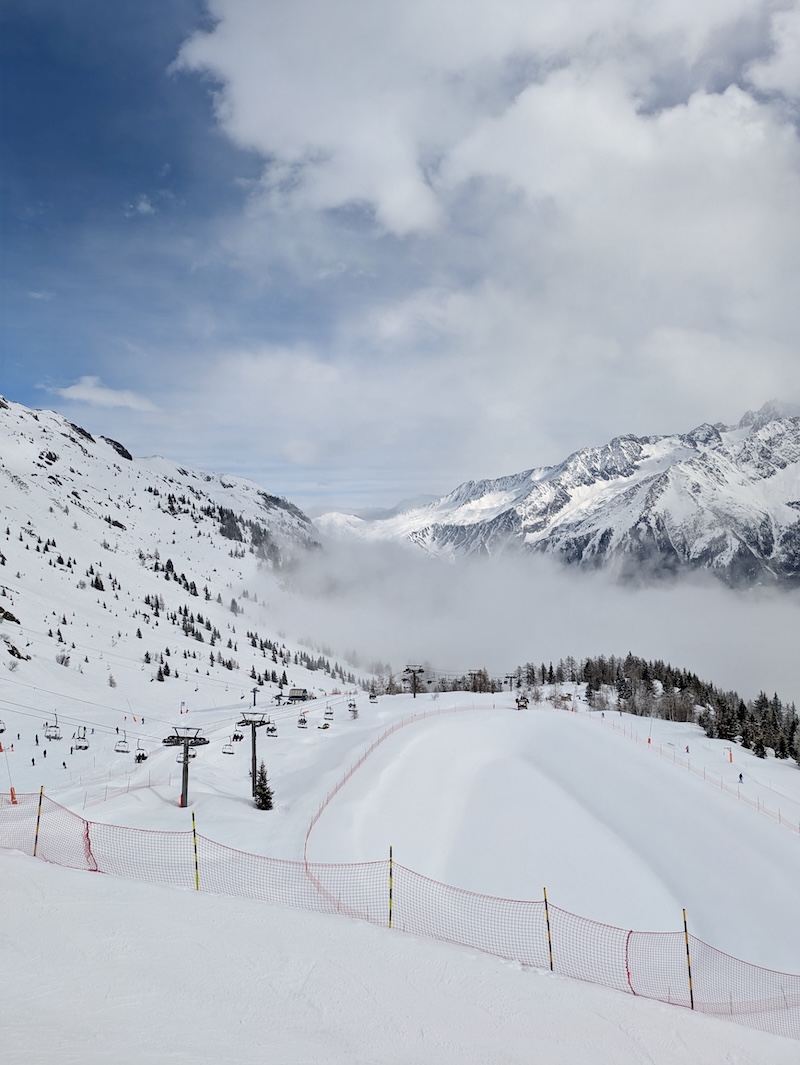
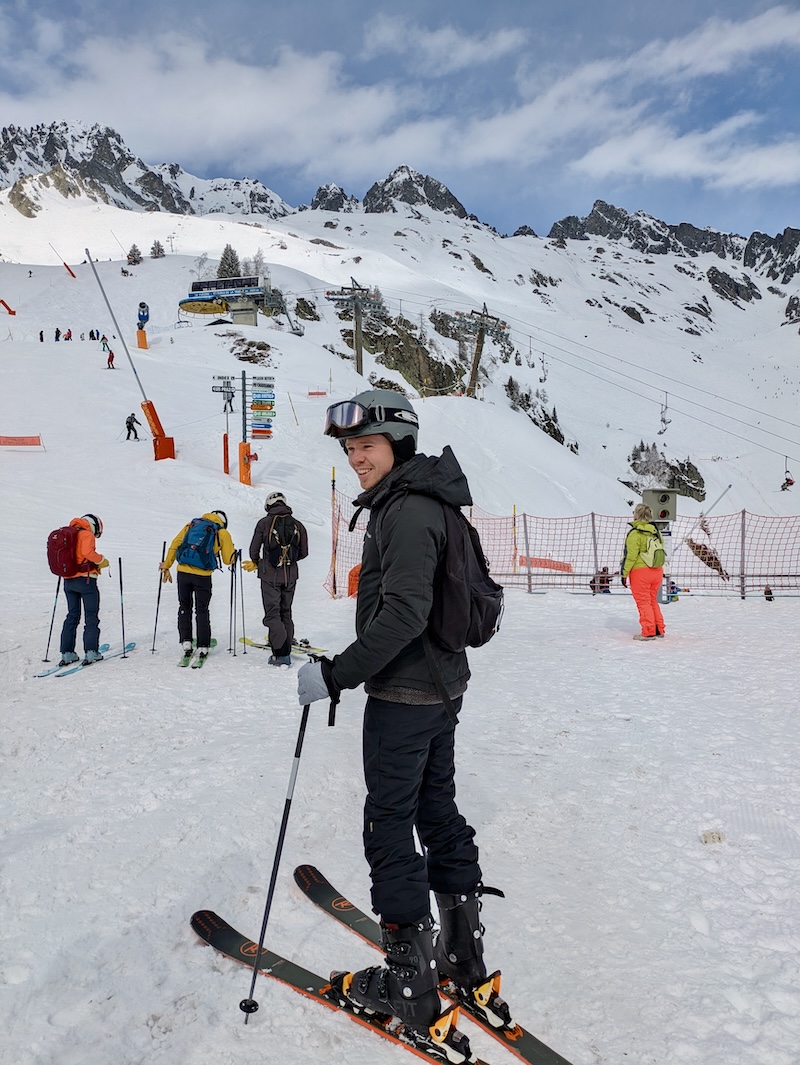
We finished the day at Le Petit Social. Intimate yet lively, this charming bar is a favourite among those in the know, serving up excellent drinks and a convivial atmosphere to toast the end of a good day on the mountain. Chamonix’s après is town-centre rather than slope-side, and the cluster around Rue des Moulins is where most of it happens.
Day 3: Bad Weather, Lac Vert and a Spa
On day three the weather closed in and we didn’t ski at all. This happens in Chamonix, and it’s worth having a plan for it. Ours was a hike from Servoz up to Lac Vert, and then further up to La Bergerie for a mulled wine. It’s a good bad-weather walk — low enough to be sheltered, pretty enough to be worth doing in its own right.
In the evening we went to the spa at Les Granges d’En Haut in Les Houches for a sauna, a swim and the hot tubs. Few things rival sitting in an outdoor hot tub while snow settles on your shoulders.
Day 4: A Half Day at Les Houches, then the Airport
Our last morning gave us the best conditions of the trip. Les Houches is tree-lined and lower than the rest of the valley, and it’s the one area here that works well for a mixed group: perfect beginner slopes for Charlie, and proper runs for Luke and Charlie’s uncle, who are intermediate and advanced respectively. If you only ski one area in Chamonix and you aren’t an expert, make it this one.
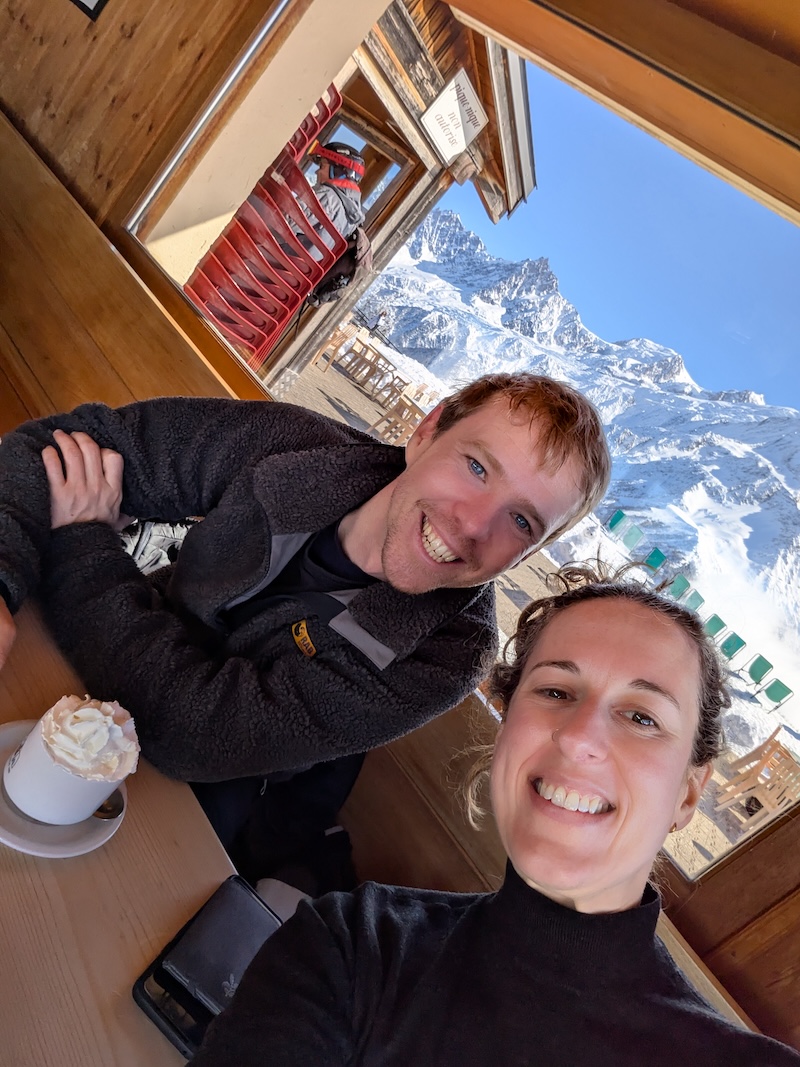
We drove straight from Les Houches to Geneva airport, which was just over an hour’s drive.
Where to Stay in Chamonix for Skiing
Where you stay in Chamonix matters more than it does in a single-lift-system resort, because it decides how much of your holiday you spend getting to the snow.
Chamonix town centre is the best base for lift access, bars and restaurants, and the Brévent cable car. Argentière is quieter and puts you closest to Grands Montets and Le Tour. Les Houches is the most relaxed of the three and suits families and anyone driving, though it’s a bus or drive from town in the evening.
There’s a fourth option: Servoz, at the mouth of the valley. It’s where we were based, ten minutes from Les Houches, well outside the Chamonix crowds, cheaper than the town, and barely over an hour from Geneva.
Before booking, check the walk to the nearest lift or bus stop before you book, as “Chamonix” covers a lot of ground, and 15 minutes extra with skis on your shoulder gets old by day three.
These are the places we’d book for a ski trip in the valley:
Hameau Albert 1er
5-star Relais & Châteaux with Michelin-starred dining, a mountain pool and breathtaking Mont Blanc views. The finest hotel in Chamonix.
Check ratesHôtel Mont-Blanc
A classic 4-star landmark right in the heart of Chamonix, with elegant rooms, a pool and consistently top ratings.
Check ratesLes Grands Montets Hotel & Spa
A 4-star spa hotel at the foot of the Grands Montets glacier, with a pool, wellness facilities and direct access to some of the valley’s best trails.
Check ratesThe Spa at Les Granges d’En Haut
We didn’t stay here — our base for all four nights was family in Servoz — but we spent an evening at the spa at Les Granges d’En Haut in Les Houches, and it was one of the best decisions of the trip. Sauna, pool and outdoor hot tubs, with easy access to the Prarion cable car. On the strength of that alone, it’s the place in the valley we’d book if we weren’t staying with family.
What Our Chamonix Ski Trip Cost
Car Rental
- Alamo (Renault Clio four days): £411
Ski Passes
- La Flégère (Adult Day Pass): €71
- La Flégère (Adult, Non-Skier Pass): €39.50
- Les Houches (Adult Day Pass): €57
- Optional: Ski pass insurance available for €3.50 per day
Ski Rental
- Ski boots & skis: From €31 per day (includes skis, boots, and helmet)
Chamonix Skiing FAQs
Chamonix is one of the best ski destinations in the world for confident and expert skiers, thanks to its high, steep terrain and legendary off-piste. It’s less suited to intermediates who want long linked pistes, because the valley’s ski areas are separate rather than joined up.
For beginners, it’s workable rather than ideal. The nursery slopes at Le Savoy, Les Planards and La Vormaine are good, and Domaine de Balme is a gentle next step. However, beginners travel more between areas here than in a purpose-built resort, so a first-timer holidaying alone might be happier elsewhere. It would also be cheaper to learn to ski somewhere like Bulgaria or Macedonia than here but a lot.
Yes, Chamonix is expensive for skiing. It’s mid-to-high end for the French Alps. Lift passes are comparable to other major resorts, but you can keep costs down by buying single-area day passes instead of a full valley pass, hiring skis outside the town centre, and staying in Les Houches or Argentière rather than central Chamonix.
For the 2025/26 season, a 3-day adult Mont Blanc Unlimited pass started at around €285 and a 3-day Chamonix Le Pass at around €205. Single-area day passes were €57 at Les Houches and €71 at La Flégère. Prices for 2026/27 are released in the autumn.
Mid-January and the second half of March are the best times to ski in Chamonix. They give the best balance of snow, space and price. Avoid Christmas, New Year and February half-term unless you’re happy with crowds and peak rates.