

Deciding where to stay in Amsterdam matters more than you expect. The city is small enough that you can walk between neighbourhoods in twenty minutes, which makes it tempting to book the first central hotel you find and assume location is solved. That’s exactly what I did the first time, and now I know better!
I’ve been to Amsterdam three times now, in three completely different ways: once as a student who hitchhiked there, once for a work conference, and most recently for a proper weekend in the east of the city. Between these trips, I’ve stayed dead in the centre, right out in the Docklands, and in a leafy pocket most visitors never reach.
This guide is what I learned about the best places to stay in Amsterdam.
In a Rush? The Best Hotels in Amsterdam
Hotel V Oosterpark
A stylish boutique hotel in Amsterdam East with modern rooms, great cafés nearby and easy tram connections into the city centre. A quieter base away from the busiest tourist areas.
Check ratesThe Dylan Amsterdam
A luxury five-star boutique hotel overlooking one of Amsterdam’s canals, offering elegant rooms, exceptional service and an unbeatable central location.
Check ratesVolkshotel
A creative, design-led hotel in Amsterdam Oost with a rooftop bar, hot tubs and lively atmosphere. Perfect if you’re after something fun and a little different.
Check ratesMilkhouse Luxury Stay
A beautifully designed luxury apartment stay in the Canal Belt, combining boutique-hotel style with the privacy of your own space in the heart of Amsterdam.
Check ratesThe Best Areas to Stay in Amsterdam at a Glance
Our favourite hotel in the city: Hotel V Oosterpark. It’s one of the best hotels we’ve stayed at anywhere in Europe.
- Best for first-timers — The Jordaan. Canals, bakeries and independent shops, still walkable to everything
- Best for a quieter, greener stay — Oud-Oost, around Oosterpark. Our favourite, and where we’d book again for future stays.
- Best for museums — Oud-Zuid / Museumplein.
- Skip — The Docklands and the Eastern Docklands, unless you have to.
| Area | Best For | The Trade-Off |
|---|---|---|
| The Jordaan | First-timers, couples, cafés and canals | Popular, so book early and expect higher prices |
| Oud-Oost (Oosterpark) | Green space, local restaurants, better value | 20–25 min walk to the canal ring |
| Grachtengordel / De 9 Straatjes | Classic canal views, central shopping | Busiest of the canal areas, priciest beds |
| Oud-Zuid / Museumplein | Museums, families, quieter evenings | Less atmospheric after dark |
| De Pijp | Food, markets, younger crowd | Lively at night; thinner on canal charm |
| Amsterdam Noord | Budget stays, something different | Ferry-dependent, feels separate from the city |
| Centrum / De Wallen | Transport links, one-night stopovers | Crowded, noisy, weakest restaurants in the city |
| Docklands / Oostelijk Havengebied | Conferences at the PTA — and nothing else | Cut off, road and rail noise, long walk in |
Compare hotel prices in Amsterdam for your dates:
First, the Mistake We Made: Booking in the Centrum
My first trip was during university. I hitchhiked from Exeter to Amsterdam, which took most of three days and a lot of standing on slip roads. I booked the cheapest hostel I could find right in the middle of town, somewhere in the seam between the Jordaan and Binnenstad, a few minutes from Centraal Station.
On the criteria I had at the time, it was perfect. It was cheap, it was basic in a way that didn’t matter at all when I was 19, and it was so close to the station that I could walk in off the train and immediately drop my backpack. If you’re arriving late, leaving early, or only have one night, being that close to Centraal is a good idea.
But here’s what I’ve learnt since (and I’ve grown up a bit): staying in the main centre of Amsterdam is not the best option for most trips. It’s busy, and it wears you down over a few days. The streets around Damrak and the Nieuwendijk are wall-to-wall with people, the shopping is the same chains you get everywhere, and the restaurants are the weakest in the city. The best places to eat in Amsterdam are almost all a ten-minute walk further out, in neighbourhoods where locals live.
Amsterdam is compact, so you do not need to be in the centre to be central.
The Best Area to Stay in Amsterdam for First-Timers: The Jordaan
If you’re coming for the first time and you want the Amsterdam with quaint canals you’ve pictured, stay in the Jordaan.
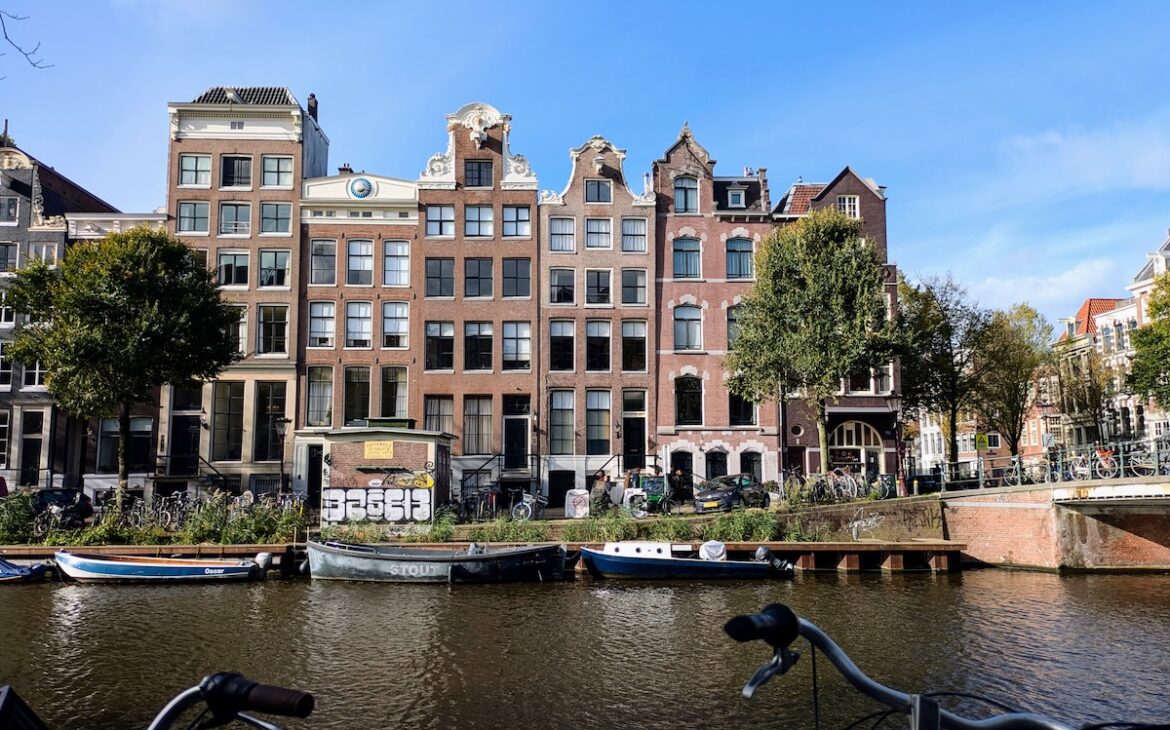
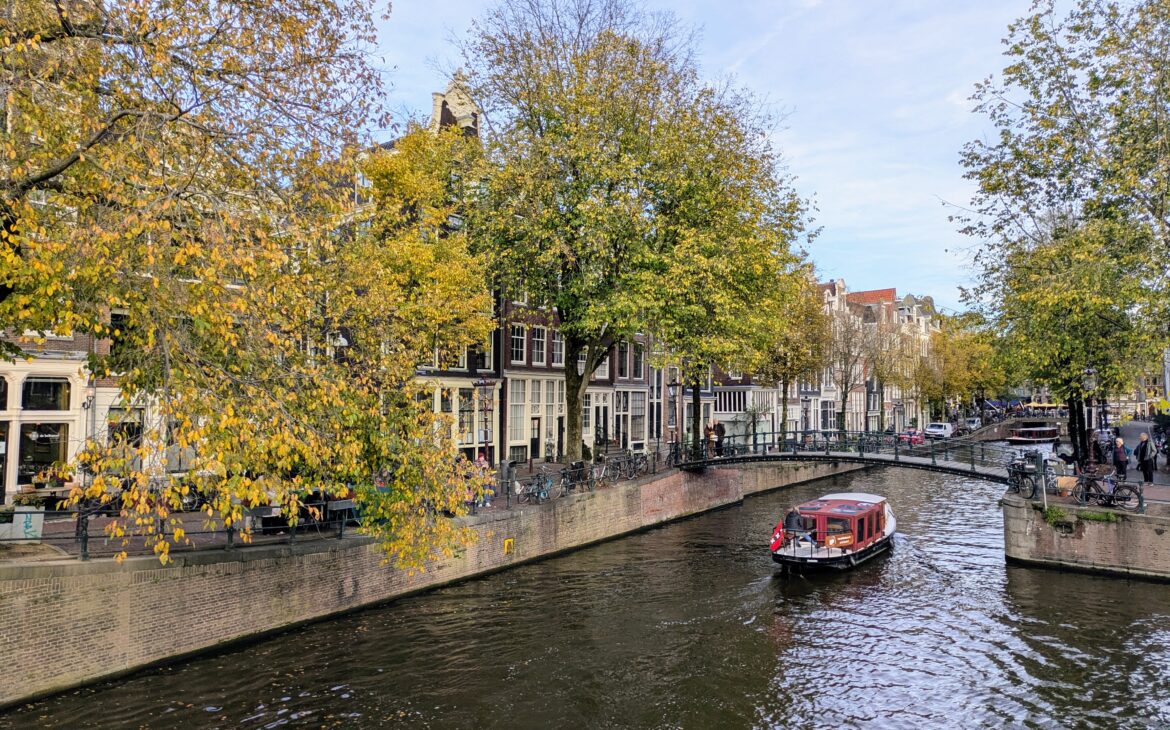
It sits just west of the centre, close enough that you can walk to Dam Square in about ten minutes, but far enough that the crowds thin out the moment you cross into it. The main draw is the back canals — the quieter waterways behind the main ring, lined with narrow gabled houses and houseboats, where you can wander for an hour without hitting a tour group. It’s the part of the city that most rewards having no plan at all.
The Anne Frank House is here, on the Prinsengracht at the Jordaan’s eastern edge, which means the streets immediately around it get busy in the middle of the day. Walk two blocks north or west and it’s quiet again.
What we love most about the Jordaan is the eating and drinking. It’s full of small independent places rather than anything that feels engineered for visitors:
- Luuk Coffee — good coffee spot
- Margo’s — good for a slower breakfast
- Oslo — reliably excellent coffee
- Café Twee Prinsen — a wine bar for the end of the day, and a lovely spot to sit outside with canal views
There are independent shops scattered through it too, and enough bakeries that you’ll find yourself building the day around one. For a first visit, this is the area that gives you canals, good food and easy walking.
Not for you if: You want the cheapest bed in the city.
The Best Neighbourhood to Stay in Amsterdam for a Quieter Trip: Oud-Oost
This is our favourite, and it’s the one you won’t find on most guides.
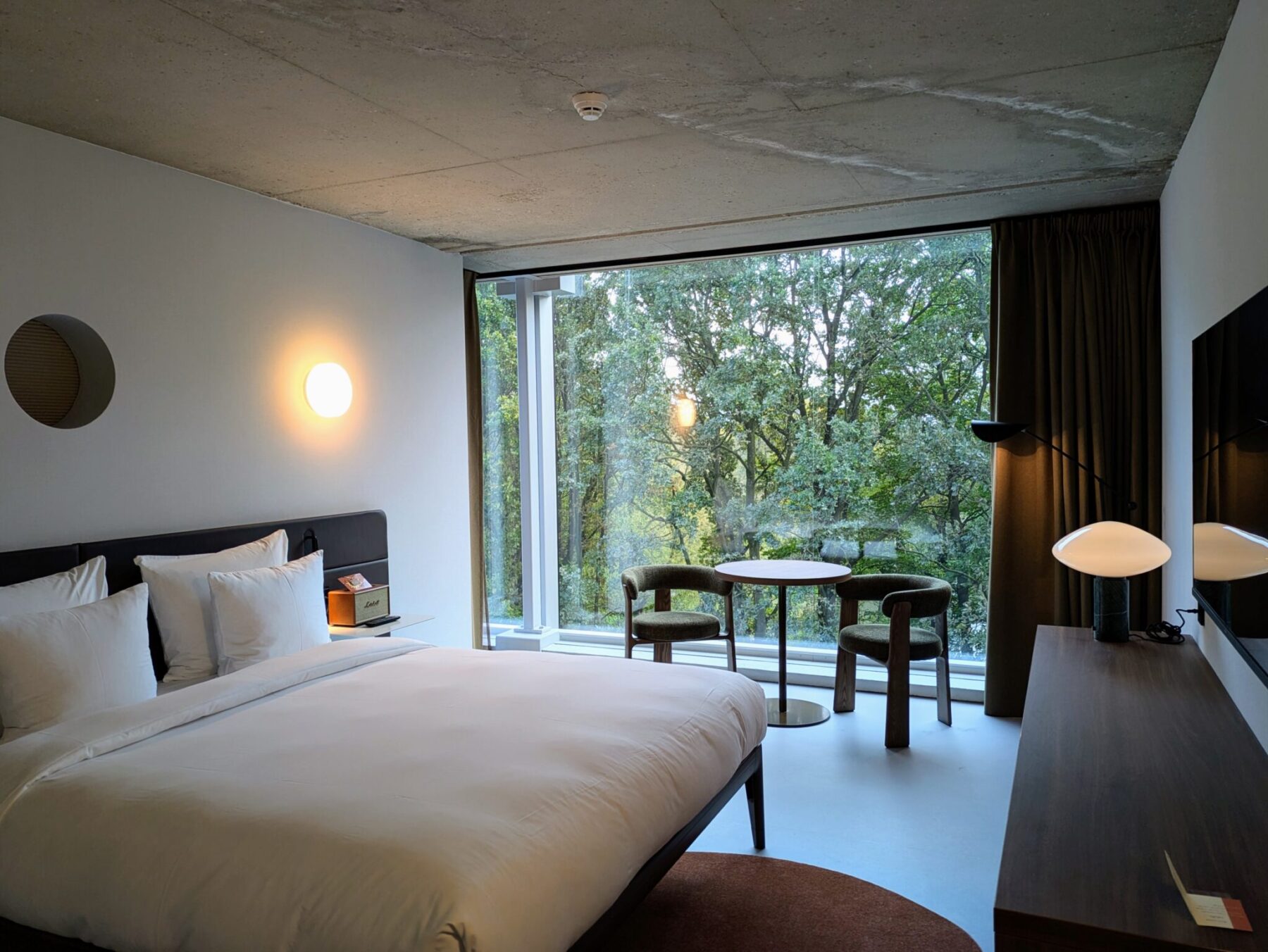
On our most recent trip we stayed at Hotel V Oosterpark, on the corner of Oosterpark itself, and it’s one of the best hotels we’ve stayed in anywhere in Europe. The rooms are properly big — a huge, plush king bed that we both slept better in than we do at home — and one entire wall was a big glass window, looking straight out over the park. We were six floors up, so the view was all leafy canopy with people cycling through the paths below. Quintessential Amsterdam!
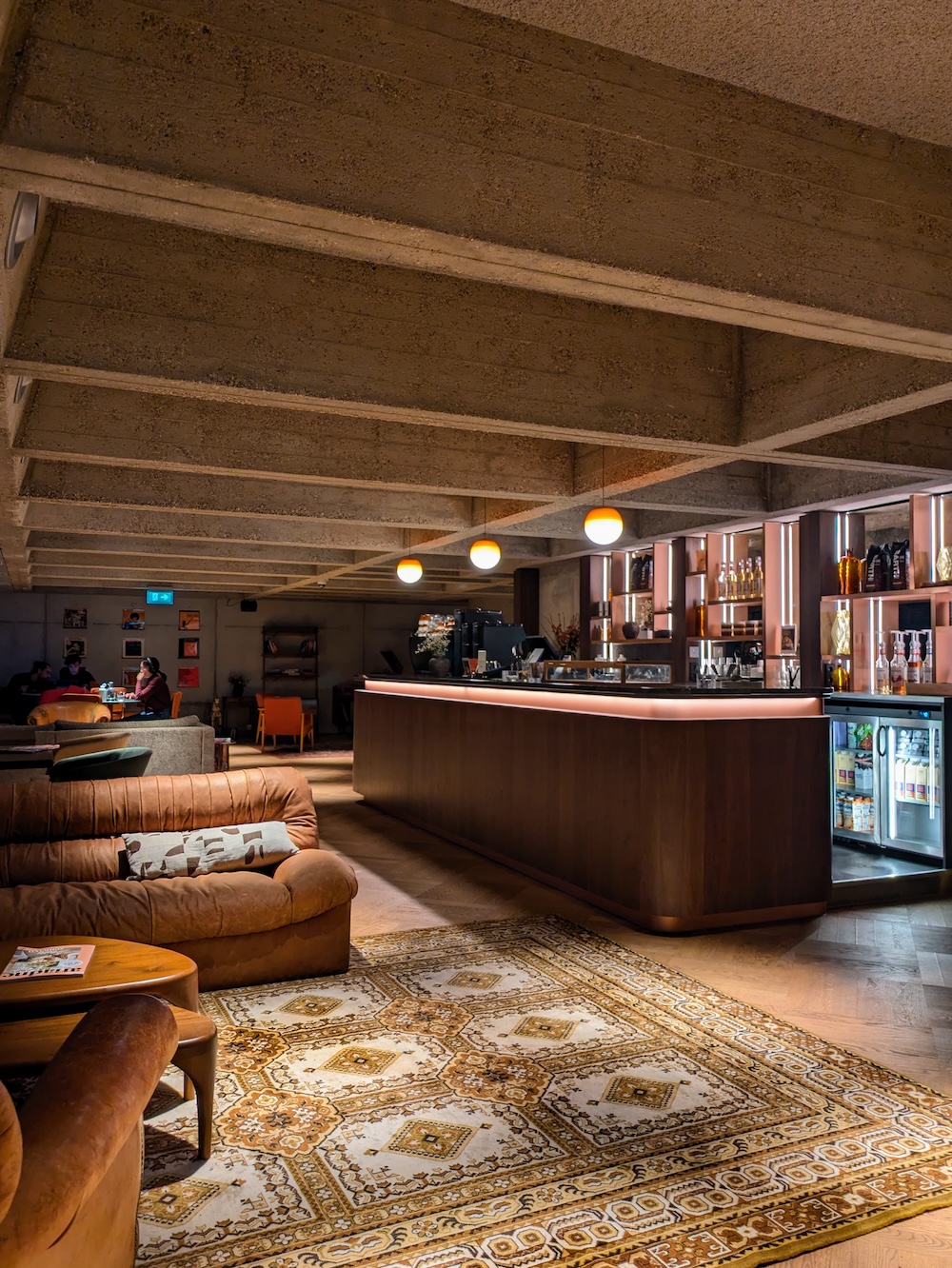
There’s a café downstairs that’s one of the better places we’ve worked from on a trip: hipster in the good way, comfortable, not pretentious, and with park views.
What makes the area work, though, is everything around it. Oud-Oost is residential and green and almost entirely untouristed, but it’s still only a short walk or a few minutes on the tram from the canal ring. You get to see a part of the city where people actually live, and then be among the canals whenever you want.
The food nearby is a real strength:
- Tomatillo — Mexican, and very good
- Al Dente Pastalab — Very basic decor, but fresh pasta and homemade tiramisu that more than makes up for it
- Olaf Brood — The local bakery
- Kaffee — The neighbourhood coffee spot
If you want somewhere a little more suburban, with green space and local restaurants and a sense of a neighbourhood, stay here. It’s the recommendation we make to friends now.
Not for you if: You want to roll out of bed into the canal ring, or you’re only in town for one night.
Other Amsterdam Neighbourhoods to Consider (That We Haven’t Slept In)
We haven’t stayed in these, so we’re not going to pretend otherwise — but they come up constantly and they’re worth knowing about.
Grachtengordel and De 9 Straatjes
Grachtengordel and De 9 Straatjes is the canal ring proper: the postcard Amsterdam of stacked gabled houses and bridges, with the Nine Streets running through it full of small shops and cafés. It’s the most classically beautiful place to stay and priced accordingly. Central, walkable, busy.
The canal ring is the seventeenth-century city that ended up on the postcards, and it has been a UNESCO World Heritage site since 2010. The Nine Streets are the short cross-streets running between the main canals, and they’re the one part of central Amsterdam where the shopping is independent rather than the same chains you get on Kalverstraat. The Anne Frank House sits at the northern end, on Prinsengracht.
What you’re paying for here is the view and the walk home. Almost everything in the centre is within twenty minutes on foot, and you get the gabled houses and the bridges from your own front door. What you give up is quiet and value: this is the most expensive part of the city to sleep in, the streets stay busy well into the evening, and rooms in the old canal houses are often small, with steep stairs and no lift.
Best for: a first trip where the canals are the point, couples, and short stays.
Compare places to stay in the Amsterdam canal ring
Oud-Zuid and Museumplein
Oud-Zuid and Museumplein is where the Rijksmuseum, the Van Gogh Museum and the Stedelijk sit, backing onto the Vondelpark. It’s calmer, greener and better suited to families, with the trade-off that evenings are quiet and you’ll be walking or taking a tram in for dinner.
This is the museum quarter and it’s laid out like one: the three big museums face the same open square, the Concertgebouw is at the far end, and the Vondelpark starts a few streets west. It’s the greenest central area and by some distance the most residential, which is why it suits families and anyone travelling with small children.
The trade-off is atmosphere. Oud-Zuid empties out in the evening, and the streets around the museums have more coach parking than restaurants. You’ll walk or take a tram in for dinner most nights, which is fine if you want your base calm and inconvenient if you want to fall out of a bar and into bed.
Best for: families, museum-led trips, and anyone who wants space and quiet.
Compare places to stay in Oud-Zuid
De Pijp
De Pijp is the foodie neighbourhood — the Albert Cuyp market, a dense run of restaurants and bars, and a younger crowd. Great if eating out is the point of your trip, less so if you want canal views from your window.
The Albert Cuyp is the largest daily street market in the Netherlands and it sets the tone for the whole neighbourhood: cheap food, a lot of it, and a crowd that skews young. Ferdinand Bolstraat runs the length of it, the north–south metro line has a stop in the middle, and the Sarphatipark gives you somewhere to sit down. The Heineken Experience is at the northern edge, closer to the canal ring than to the good bits.
De Pijp is roughly fifteen minutes’ walk from the Rijksmuseum and about the same again into the canal ring, so you’re close without paying canal-ring prices. What it doesn’t have is a view. This is a nineteenth-century grid of brick apartment blocks, and if you’ve come to Amsterdam for water outside the window, it isn’t here.
Best for: eating and drinking, younger travellers, and better value than the centre.
Compare places to stay in De Pijp
Amsterdam Noord
Amsterdam Noord is across the IJ, reached by a free ferry from behind Centraal. It’s the budget-friendly option and has a distinct, slightly industrial-creative character, but you’re dependent on the ferry and it doesn’t feel like part of the same city.
Noord is the cheapest place to sleep within reach of the centre, and the reason is the water. The free passenger ferries run from behind Centraal Station around the clock and the crossing takes a few minutes — but it is a crossing, and that gap is what keeps the prices down. The NDSM wharf, a former shipyard about fifteen minutes out by ferry, is the part worth going for: studios, street art, festivals in summer and a genuinely different feel from anywhere south of the IJ.
Be honest with yourself about the ferry before you book. If you’re the kind of traveller who’ll happily wait ten minutes for a boat at midnight, Noord is the best-value bed in Amsterdam. If you’re not, you’ll resent it by day two.
Best for: budget trips, longer stays, and anyone who wants somewhere that doesn’t feel like a tourist centre.
Compare places to stay in Amsterdam Noord
Oud-West
Oud-West sits between the Jordaan and Vondelpark and is a reasonable middle ground: residential, decent food scene, less expensive than the canal ring.
Oud-West is the compromise pick. You’re a short walk or one tram stop from the Jordaan, the Vondelpark is on your doorstep, and you pay noticeably less than you would two streets east. The Foodhallen, an indoor food market in a converted tram depot on the Hannie Dankbaarpassage, is the anchor most people know it for, and Kinkerstraat gives you an ordinary high street rather than a tourist one.
It has less character than the Jordaan and fewer restaurants than De Pijp, which is precisely why it’s cheaper. If the canal ring is out of budget and Noord feels too far, this is the sensible middle.
Best for: value near the centre, second visits, and travellers who want a residential base without the ferry.
Compare places to stay in Oud-West
The Best Location to Stay in Amsterdam by Trip Type
There isn’t one best part of Amsterdam to stay in, because the city is small and the right answer changes with what you’ve come for. This is how we’d choose:
- First trip, three nights — The Jordaan. You get the canals, you can walk everywhere, and it still feels like a neighbourhood rather than a thoroughfare.
- Second or third trip — Oud-Oost or Oud-West. Cheaper, quieter, and you’ll see a version of the city you missed the first time.
- Travelling with children — Oud-Zuid, for the Vondelpark, the museums on your doorstep and streets you can actually push a buggy down.
- Here to eat — De Pijp. The Albert Cuyp, and the highest concentration of restaurants per street in the city.
- On a budget — Amsterdam Noord, as long as you’re genuinely happy with the ferry. Otherwise Oud-West.
- One night, early train — Somewhere close to Centraal. This is the one case where the Centrum earns its keep.
- A week or more — Oud-Oost. At that length you want a neighbourhood you can live in rather than a location you can sightsee from.
- A conference at the RAI or the PTA — Book near the venue and accept the trade-off, or stay in the city and travel in. See the Docklands section below before you decide.
If you want one rule: stay just outside the canal ring, not inside it. You lose five minutes of walking and you gain most of what makes a trip here enjoyable.
Where Not to Stay in Amsterdam: The Docklands
I can be specific about this one, because I stayed there!
One of my Amsterdam visits was for a work conference at the Passenger Terminal Amsterdam, the big venue out on the eastern waterfront. I stayed at the Mövenpick Hotel Amsterdam City Centre, which sits directly beside it. The name is doing a lot of work there. It is not the city centre.
The hotel itself is fine, and the views over the port are good, but the location isn’t great. It’s a 25-minute walk back into town, which is long enough that you don’t want to do it more than once. It sits right up against a main road and the train tracks, so it can be noisy and not aesthetically pleasing depending on which side of the hotel your room faces. The transport connections are fine, but not easy.
If you have a conference at the PTA, it’s the obvious choice and it works fine given it’s a ten-second commute. For a weekend away, or a first visit, or any trip where you’re not contractually obliged to be there, stay somewhere else.
How Long to Stay in Amsterdam
Amsterdam works well as a long weekend. Three nights is enough to see the major museums, walk most of the canal ring, and still have an afternoon with nothing planned — which is when the city is at its best.
If you’re staying longer than four nights, I’d suggest picking a neighbourhood like Oud-Oost or De Pijp over the canal ring. The centre is more enjoyable to visit than to live in, and the further out you base yourself, the more the trip feels like a stay rather than sightseeing.
Getting Around from Each Area
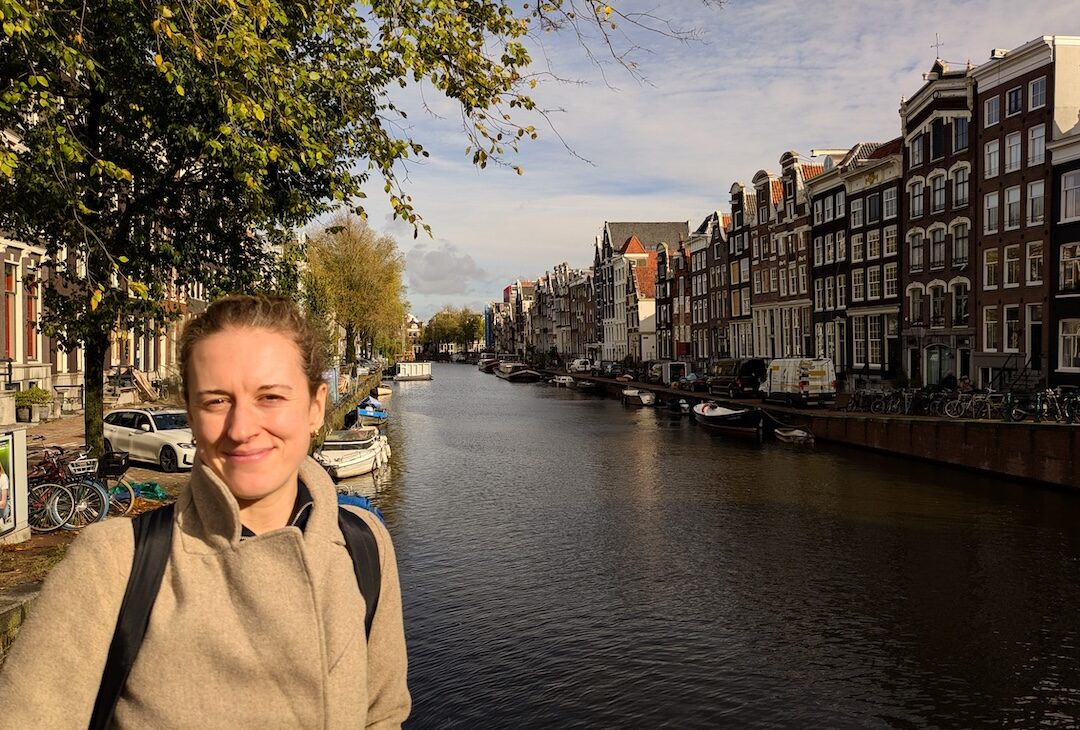
Amsterdam is walkable, and the tram network covers everything the walk doesn’t. From the Jordaan you can reach the centre, the Nine Streets and Westerpark on foot. From Oud-Oost, it’s around 20–25 minutes to walk into the canal ring, or a few minutes by tram.
Cycling is the obvious option everywhere, and most hotels can arrange hire. If you’ve never cycled in Amsterdam before, be aware the bike lanes move quickly and the etiquette is real.
The one thing worth planning around is Centraal Station. If you’re arriving late at night or catching an early Eurostar, the ten minutes you save by being close to it is the strongest argument for staying central — and just about the only one.
Where to Stay in Amsterdam FAQ
The Jordaan. It has the canals and the atmosphere people come for, it’s a ten-minute walk from the centre, and the food is far better than anything you’ll find around Dam Square. If it’s out of budget, Oud-West or De Pijp are good alternatives.
Amsterdam Noord has the best-value beds, with the ferry from behind Centraal running free and frequently. Oud-West and the eastern edge of Oud-Oost are cheaper than the canal ring while still being walkable. Central hostels are cheap but you’re paying in noise.
The Docklands and Eastern Docklands, unless you have a conference at the Passenger Terminal. It’s a long walk from anywhere, noisy from the road and railway, and poorly connected. We’d also steer most people away from De Wallen for anything other than a single night.
Oud-Oost, around Oosterpark. It’s residential and green, the restaurants are local rather than touristy, and you’re still a short tram ride from the canals.
The Jordaan for canals, small bars and quiet nights. Oud-Oost around Oosterpark for value and a neighbourhood that still belongs to the people who live in it, which is where we stayed at Hotel V Oosterpark. De Pijp if you plan your days around food, and Oud-Zuid if the museums are the reason you came.
Hotel V Oosterpark, for the price and the walk into town along the park. Mövenpick Hotel Amsterdam City Centre if you want something bigger and closer to Centraal. Both are in our picks above with current prices.
Just outside the canal ring. The Jordaan if it’s your first trip, Oud-Oost or Oud-West if it isn’t. Staying inside the ring costs more and buys you about five minutes of walking. Staying well outside it, in Noord or the Docklands, costs you the ability to walk home.
The Jordaan for canals and atmosphere, Oud-Oost for green space and value, Oud-Zuid for museums and families, De Pijp for food, and Oud-West as the middle ground. Grachtengordel is the most beautiful and the most expensive. Noord is the cheapest, with a ferry attached.
Oud-Zuid. The Vondelpark is right there, the three main museums sit on one square, the streets are residential and wide enough for a buggy, and it is quiet in the evening. The trade-off is that you will travel in for dinner most nights.
Outside it, for almost every trip. The centre around Damrak and Nieuwendijk is crowded, the shopping is the same chains you get everywhere, and the restaurants are the weakest in the city. The exception is a single night before an early train, when walking distance to Centraal beats everything else.
This guide contains affiliate links. If you book through them we may earn a small commission at no extra cost to you. We only ever recommend places we have stayed or would happily book ourselves.