
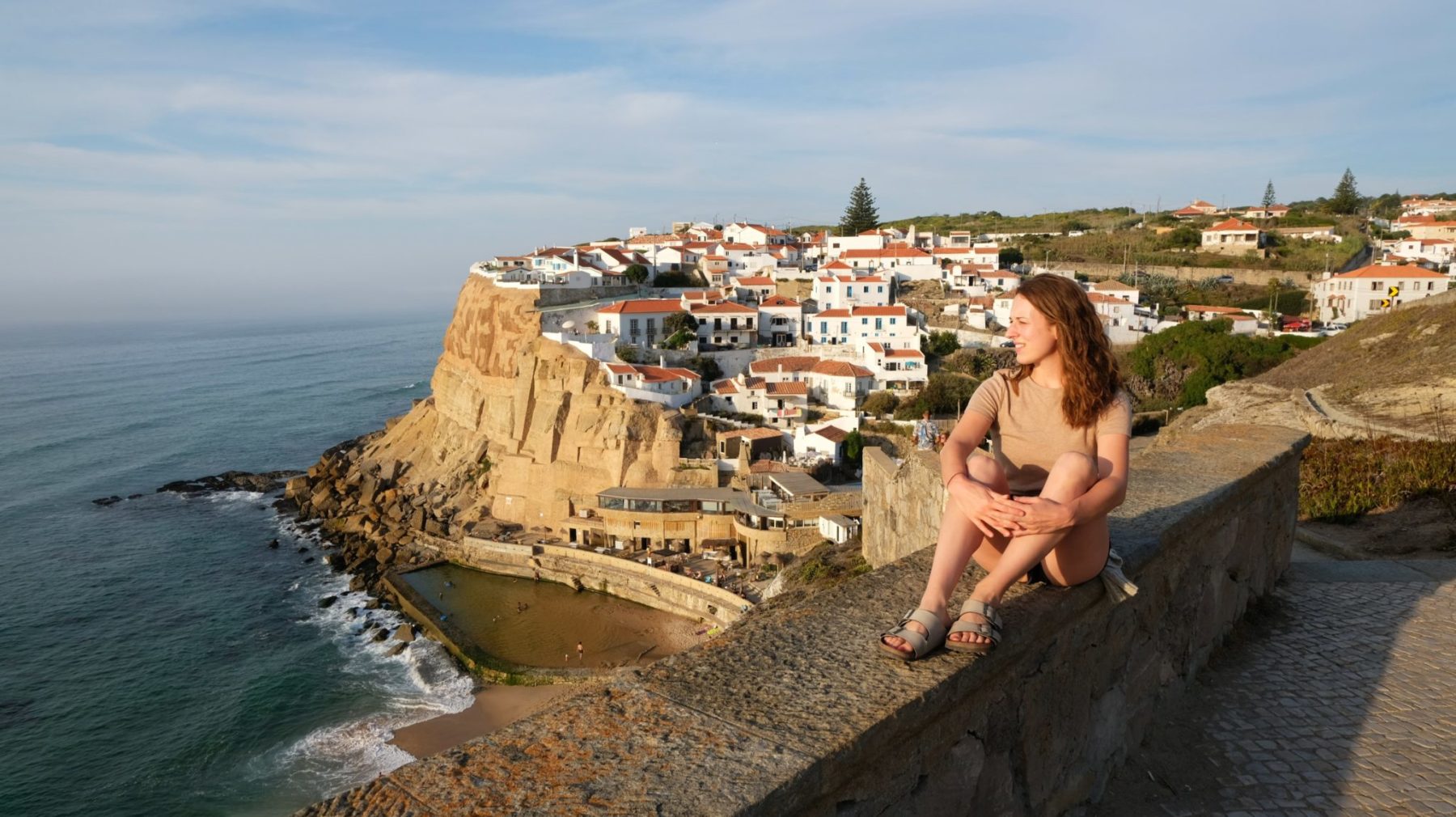

Most travel guides will send you straight to Cascais — and Cascais is great — but the Lisbon coast isn’t one beach. It’s a string of beaches and most are reachable by train in 25 to 40 minutes. After a week based in Graça in Lisbon last this year, I headed to a few different beaches on a hot weekend to explore.
Of the beaches near Lisbon, some are surf meccas, some are local-lunch spots, some are tiny rock-pool coves the guides never name. Here are the beach spots I most love in the Lisbon area.
In this guide
In a Rush? Our Favourite Lisbon Hotels
Browns Avenue Hotel
A stylish adults-only stay just off Avenida da Liberdade, with mid-century rooms, a library honesty bar and a rooftop pool above the city.
Check ratessamesame Co-living & Co-working
Lisbon’s first creative co-living space, near Baixa and Chiado, with private rooms and apartments, two co-working studios and a community Sunday brunch — ideal for stays of a week or more.
Check ratesSolar do Castelo
The only hotel inside the walls of São Jorge Castle: an 18th-century palace with 20 characterful rooms, garden breakfasts and resident peacocks strutting the courtyard.
Check ratesH10 Duque de Loulé ⭐⭐⭐⭐
A boutique four-star near Marquês de Pombal with hand-painted azulejos in the rooms and the 10th-floor Limão rooftop bar looking out over the Tagus.
Check ratesWhy “the Lisbon Coast” isn’t One Beach
Lisbon sits at the mouth of the Tagus, where the river meets the Atlantic. Head west out of the city by train and you trace a coast that gets steadily wilder — pebble town beaches first, then surf-pummelled cliffs, then the wind-bowled stretch out to Cabo da Roca, mainland Europe’s westernmost point. Head south across the river and you find a totally different coast: long flat sand, pine forest behind, and prices that drop the moment you cross the bridge.
You don’t need a car for any of it. The Cascais train line covers the whole western coast for the price of a metro ticket, and ferries from Cais do Sodré or Belém will get you to the south side in 20 minutes.
The Cascais Line, Beach by Beach
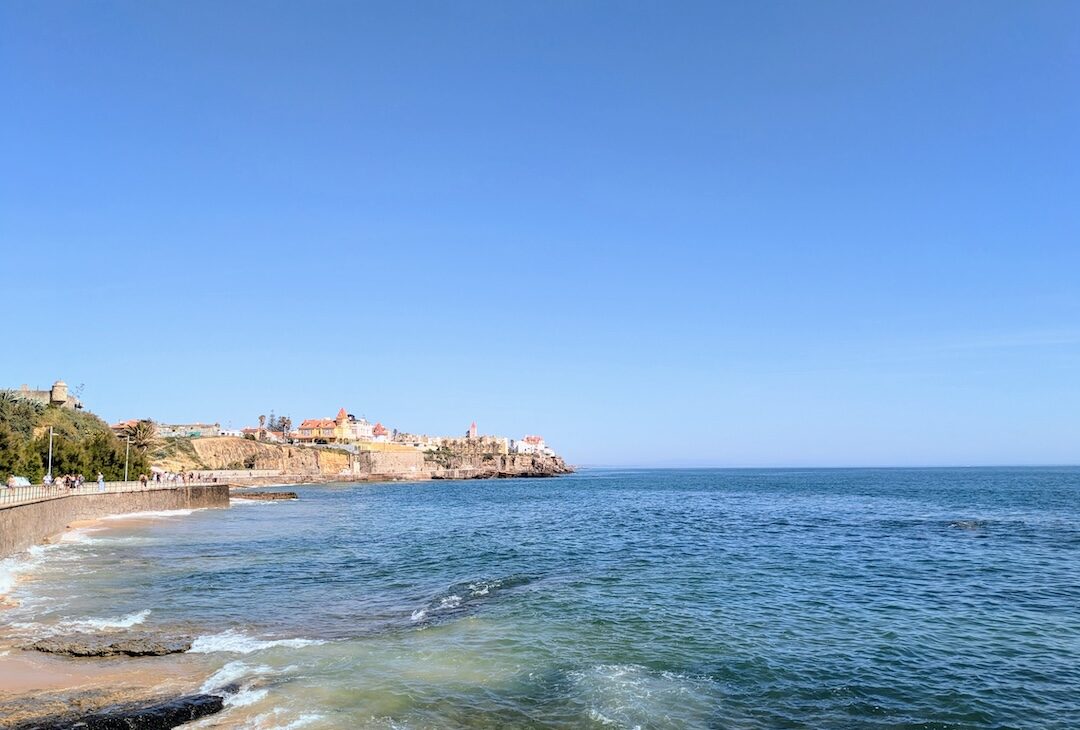
The Cascais line leaves from Cais do Sodré station — a 10-minute walk down from Chiado, on the river. It runs along the coast all the way to Cascais (about 40 minutes) and stops at every beach worth getting off for. A single ticket is around €2.40 in 2026, but if you’re here for more than a couple of days, get a Lisboa Viva card and load it up with the monthly Navegante pass.
Carcavelos — the big surfable beach 25 minutes from central Lisbon
If you want a proper Atlantic beach without spending an hour getting there, Carcavelos is the answer. Twenty-five minutes from Cais do Sodré, then a five-minute walk from Carcavelos station, and you’re on a kilometre of soft yellow sand with surfable waves rolling in.
It’s the surf-school beach for Lisbon — beginner-friendly, board rentals from a row of beach shacks, instructors who’ll meet you at the station. If you’ve never surfed before, this is where to try it. The waves are forgiving and the water’s shallow. You can rent a board directly on the beach at Feel Free Surf School.
We spent a morning reading on this beach before hiking along the coast to the next set of beaches. We wouldn’t recommend the walk, as it’s road-side, so plan a full day here instead.
Praia de São Pedro do Estoril — the small, calm rock-pool beach
Three stops further along the line is São Pedro do Estoril. Get off at São Pedro do Estoril station, walk down past the church, and you’ll come to a small cove tucked between two rocky outcrops. There’s a thin strip of sand at the centre and rock pools at either end that fill with warm, clear water at low tide.
It’s never empty as it’s a local favourite, but it’s never the kind of crowded that Cascais and Carcavelos can be in August. We enjoyed chilling at this beach, laying on the rocks for a sunbathe, and best of all there’s a great coffee and lunch spot just a 3-minute walk into the village called Restaurante Fauna & Flora.
Praia da Azarujinha — where the 20-somethings hang
After a long afternoon walk in the sun, we hit Praia da Azarujinha and it was our favourite beach stop of the day. This concreted area of sea walls gives plenty of space to lay your beach towel and enjoy reading with sea views. There’s a toilet block too.
The beach here is a tiny sandy bay, which is perfect for quick dips in the water between sunbathing, but doesn’t constitute a full beach. Most of the crowd here are younger 20 and 30-somethings. This beach isn’t set up for families or young kids due to the lack of sand and beach space, which probably explains why the younger crowd stop here.
Praia da Poça and Praia do Tamariz — long sandy stretches for families
Just round the corner from Praia da Azarujinha, you’ll find the long sandy beaches of Poça and Tamariz. If you want a classic sandy beach, these are the beaches for you. These beaches are much better suited to families as there’s lots of sand, lots of space, and easy access to the sea without many rocks.
Both beaches are close to Estoril station and easily walkable from there, and you’ll find ice cream kiosks the full way along.
Cascais itself — town beach vs walking up to Boca do Inferno
Cascais is the line’s end stop and it is as pretty as everyone says. The old town is small enough to wander in an hour, the marina is full of polished sailboats, and the three town beaches (Praia da Conceição, Praia da Rainha, Praia da Ribeira) are sheltered, gentle and busy.
If you’re done with reading on the beach, the coast gets dramatic the moment you walk west out of town. Follow the seafront promenade for 25 minutes and you’ll arrive at Boca do Inferno — “Hell’s Mouth” — a rocky chasm where the Atlantic crashes into a half-collapsed sea cave. It’s free, it’s wild, and makes for a great short wlak.
Keep walking past Boca do Inferno and you can carry on all the way to Praia do Guincho (about 6km from Cascais centre) — the wind-blasted, surfer-favoured beach where the cliff walk officially ends. North of Guincho the coast keeps going into the Sintra-Cascais Natural Park, and the clifftop walk from Azenhas do Mar to Cabo da Roca is the best of it on foot.
Sesimbra & the Arrábida coast — dolphins, vineyards and quiet coves
For something quieter and harder to reach, head south. Sesimbra is a fishing village 50 minutes from Lisbon by bus (catch the 207 from Praça de Espanha) on the southern edge of the Arrábida natural park. Whitewashed houses tumble down to a sheltered bay and the water is turquoise.
Behind Sesimbra is the Arrábida Natural Park — a small mountain range of pine, scrub and limestone, dotted with hidden coves you can only reach by boat or by a short, steep hike. Vineyards on the inland slopes produce some of Portugal’s best Moscatel. From April to October, dolphin-watching boats run from the harbour.
Ericeira — surf town, sunset bars
Ericeira is Portugal’s surf town. It was the first World Surfing Reserve in Europe, and there are eleven surf breaks within a few kilometres, ranging from beginner-friendly Foz do Lizandro to the heavy reef at Ribeira d’Ilhas (where the WSL pro tour stops every year).
Ericeira is small enough to wander in a morning. Grab a board from one of the dozens of surf shops, take a class at Foz do Lizandro, and stay for the sunset. The cliffs west of the old town face directly into the setting sun and the bars on the seafront fill up around 7pm. If you stay overnight, this is the kind of place where you might wish you stayed longer.
To get there from Lisbon, take the Mafrense bus from Campo Grande (about 1h 10m), which runs every 30 minutes and costs around €6 each way.
Costa da Caparica — the local-lunch beach
Cross the 25 de Abril bridge — or take the ferry from Cais do Sodré to Cacilhas and the local bus from there — and you’re on Costa da Caparica. This is the beach Lisboetas go to: a long, flat ribbon of yellow sand running for nearly 30km south, lined with relaxed beach restaurants and not a souvenir shop in sight.
The Transpraia, a little open-sided train, runs in summer along the back of the dunes from the Costa da Caparica town all the way down to Fonte da Telha (about 9km). It stops at twenty numbered beaches. Praia 19 (Bela Vista) is the LGBTQ+ favourite; Praia 13 has a restaurant scene; Praia 21 is where the surfers go.
Comporta — where Lisbon goes in August
An hour and a half south of Lisbon, past rice paddies and pine forest, you reach Comporta — the chic-but-low-key beach village where Lisbon’s in-the-know crowd disappear in August. The beach is enormous, the dunes are protected, and the rule is: no high-rises, no traffic, no rush.
It’s not a day-trip in the way Cascais or Caparica are. The bus is slow, an Uber will run €60–80 each way (for what everything else in Lisbon costs, see how much to budget for Lisbon), and most of the good restaurants and stays book up weeks in advance in summer. If you want to go, plan a one- or two-night stay rather than a day-trip, and book early.
Style-wise: think rope-and-cane interiors, wood-fired bread for breakfast, sunset on the dunes, dinner barefoot. It’s the most expensive option in this guide.
How to Get to Each Beach from Lisbon (train fares, journey times, Uber prices)
| Beach | How | Time | Cost (one way) |
|---|---|---|---|
| Carcavelos | Cascais line train (Cais do Sodré) | 25 min | €2.40 |
| Praia de São Pedro do Estoril | Cascais line train | 30 min | €2.40 |
| Cascais (town beaches & cliff walk) | Cascais line train | 40 min | €2.40 |
| Praia do Guincho | Train to Cascais + 405 bus, or Uber from Cascais | 50–60 min | €2.40 + €4 / €10 Uber |
| Sesimbra | 207 bus from Praça de Espanha | 50 min | €4.50 |
| Ericeira | Mafrense bus from Campo Grande | 1h 10 | €6 |
| Costa da Caparica | Ferry to Cacilhas + bus, or 25 de Abril bridge bus | 40 min | €3.50 |
| Comporta | Bus from Sete Rios, ferry, or Uber | 1h 30 | €8 / €70 Uber |
Prices are 2026 estimates. Uber surge pricing is real on a hot Saturday! If you’re here for more than 3 days, get a Navegante 30-day pass loaded onto a Lisboa Viva card, as it covers all metros, buses, trams, and the Cascais line for around €40.
Which Beach for Which Kind of Traveller
- First-time Lisbon visitor with one beach day — Carcavelos in the morning, Cascais & the cliff walk to Boca do Inferno in the afternoon. Both on one train ticket.
- You want quiet and rock pools — Praia de São Pedro do Estoril.
- You want to learn to surf — Carcavelos for the first lesson, Foz do Lizandro (Ericeira) once you have your feet.
- You’re here with kids — São Pedro do Estoril (rock pools, lifeguards, café) or Caparica Praia 13.
- You want a long, slow lunch by the sea — Costa da Caparica.
- You want one perfect cliff walk — Cascais → Boca do Inferno → Guincho, late afternoon.
- You want a special trip and don’t mind a longer journey — Sesimbra and the Arrábida coast.
- You want to be away from everything — Comporta (overnight, not day-trip).
Where to Stay near Lisbon’s Beaches
If you want to base yourself near the coast rather than in central Lisbon, here’s where to look:
- Cascais — the easiest base if you want beaches and a town to come back to. Browse stays in Cascais.
- Sesimbra — a slow, fishing-village base for the Arrábida coast. Browse stays in Sesimbra.
- Ericeira — for surfers and sunset hunters. Browse stays in Ericeira.
- Comporta — for a slower, design-led couple’s trip. Browse stays in Comporta.
- Costa da Caparica — for a beach-town feel just across the bridge. Browse stays in Costa da Caparica.
If you want to stay in Lisbon itself and day-trip out, read our guide to the best areas to stay in Lisbon. For the south-coast beaches, Belém makes a good base because the ferries leave from the same dock.
Planning more of your Portugal trip? See our Lisbon vs Porto comparison, the Carvoeiro Algarve guide, and the Burgau, Algarve guide for further-south alternatives.
Lisbon Beaches FAQ
There are not really beaches in Lisbon itself. The beaches start about 25 minutes west of central Lisbon, along the Cascais train line. Lisbon faces the river Tagus, not the open sea, so the city has waterfront and ferries but no swimmable beach. The closest proper beach is Carcavelos, which is 25 minutes from Cais do Sodré station.
Carcavelos is the closest beach to Lisbon, on the Cascais train line, about 25 minutes from Cais do Sodré station and a five-minute walk from Carcavelos station. It is a long, surfable Atlantic beach and the easiest to reach without a car. Praia de São Pedro do Estoril (30 minutes) is a good quieter alternative.
Yes, but it is the Atlantic — bracing rather than warm. Sea temperature on the Cascais line peaks around 19-20°C in August. The south-side beaches (Caparica, Sesimbra, Comporta) feel a touch warmer because the bay is more sheltered. All are clean, lifeguarded in summer, and safe to swim from where flagged.
“Best” depends on what you are after. If you want one classic day-trip with surf and a town: Carcavelos plus Cascais. If you want quiet and rock pools: Praia de São Pedro do Estoril. If you want to surf seriously: Ericeira. If you want a long lunch on the sand: Costa da Caparica. If you want a special, slower trip: Sesimbra and the Arrábida coast.